| 文件 | 最后提交记录 | 最后更新时间 |
|---|---|---|
NIP-AA: Agent Authentication via NIP-OA Credentials (#465) | 5 个月前 | |
docs(nips): NIP-AE — Agent Engrams (#575) Signed-off-by: Tyler Longwell <109685178+tlongwell-block@users.noreply.github.com> Co-authored-by: Dawn <c6237ef84fa537c78dcee78efd2d4e59f728859c7f194da42ac51ededfa0be05@sprout-oss.stage.blox.sqprod.co> | 4 个月前 | |
docs(nip-am): normative amendment — cache SHOULD/MUST + pricingIdentity + consumer cost guidance (#4632) Amends `docs/nips/NIP-AM.md` with three normative publisher-behavior changes per the cleared Usage v2 plan (plan v3, D4 + D2'). ## Changes ### 1. Cache emission semantics (D4) Replaces the unconditional `MAY` with qualified obligations: - Publishers SHOULD emit `cacheReadTokens` / `cacheWriteTokens` when the provider exposes a cache component. - Publishers MUST preserve an explicit zero when the provider reports zero. - Publishers MUST omit the field (never null or fabricated zero) when that component is unavailable to the publisher — including when the provider supports it but the harness does not surface it. An explicit carve-out in both the JSON comment block and the Numeric-validity prose exempts these fields from the payload-wide null guidance. Omission is the only valid representation for an unavailable cache component. ### 2. Optional `pricingIdentity` field (D2') Adds an optional, non-nullable `pricingIdentity` object (`authority`, `model`, `cacheClass`), defined as billing authority — distinct from the transport `Provider` enum. - `authority` is a registered billing-namespace identifier: exact lowercase hostname, no scheme, no path, no trailing slash. Registered values: `api.anthropic.com`, `api.openai.com`, `openrouter.ai`. The set extends only by NIP amendment. Pricing lookup is an exact string match on `(authority, model)`. - Present only when the publisher can prove applicability: direct official-endpoint connections prove via the actually-requested resolved model; other routes MUST receive response-supplied authoritative billing identity. - MUST omit for custom/overridden base URLs, gateways (unless the gateway is the named billing authority), unresolved aliases, and turns where usage contributions carry more than one billing identity (including identity-bearing mixed with unresolved). - `cacheClass` is omitted (not null) when not applicable. - `pricingIdentity` is optional but not nullable — omission is the only absence representation. - The existing `model` field retains its non-billing semantics (configured/session model) and is never overloaded. - Consumers MUST treat omission as "price unknown" and MUST NOT infer a price from the session `model` field. ### 3. Consumer cost guidance (D4) - Consumers MAY recompute cost estimates using the billing identity and a pricing manifest. - Consumers MUST retain the provenance of any cost value (e.g. `manifest-estimated`, `wire-reported`). - Consumers MUST NOT merge manifest-estimated and wire-reported costs into an unlabeled total. Manifest-vs-wire display preference is application policy and deliberately excluded from this NIP. ## Scope Doc-only. Single file: `docs/nips/NIP-AM.md`. --------- Signed-off-by: Will Pfleger <pfleger.will@gmail.com> Co-authored-by: npub1mn7jgtj4w2pd0g0zeuhxsa6jy6p0rewxz4kujt98my82ahfmp72sxjexk7 <dcfd242e557282d7a1e2cf2e6877522682f1e5c6156dc92ca7d90eaedd3b0f95@buzz.block.builderlab.xyz> | 2 个月前 | |
Route ACP observer traffic over relay (#421) Signed-off-by: Tyler Longwell <tlongwell@squareup.com> Co-authored-by: tlongwell-block <109685178+tlongwell-block@users.noreply.github.com> Co-authored-by: Tyler Longwell <tlongwell@squareup.com> | 5 个月前 | |
Discover alternate Buzz ACP commands (#6948) 🤖 I’m Larry. ## Summary Managed-agent definitions can now choose which installed ACP transport will launch the agent. The choice sits beside **Agent harness** while creating or editing an agent, so it is made before first deployment and remains visible afterward. Buzz discovers executable commands named `buzz-*-acp`, keeps **Buzz ACP (default)** as the safe default, and preserves existing custom command values. Discovery and launch share the same resolver, so a command offered in the picker is the command Buzz will execute. ## UX walkthrough ### 1. The ACP command picker appears while creating the agent The default is explicit, and the helper text explains that this selection controls deployment. 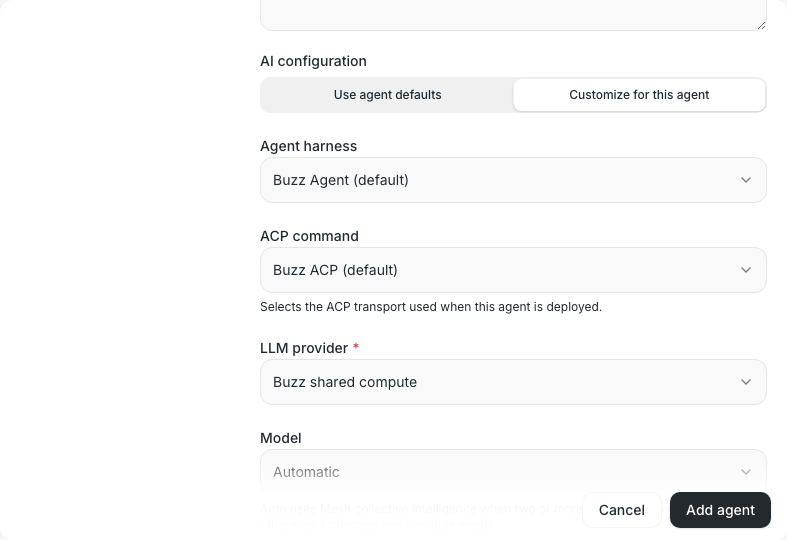 ### 2. Installed wrapper commands are offered by name Here Buzz has discovered `buzz-janet-acp` alongside the stock transport. 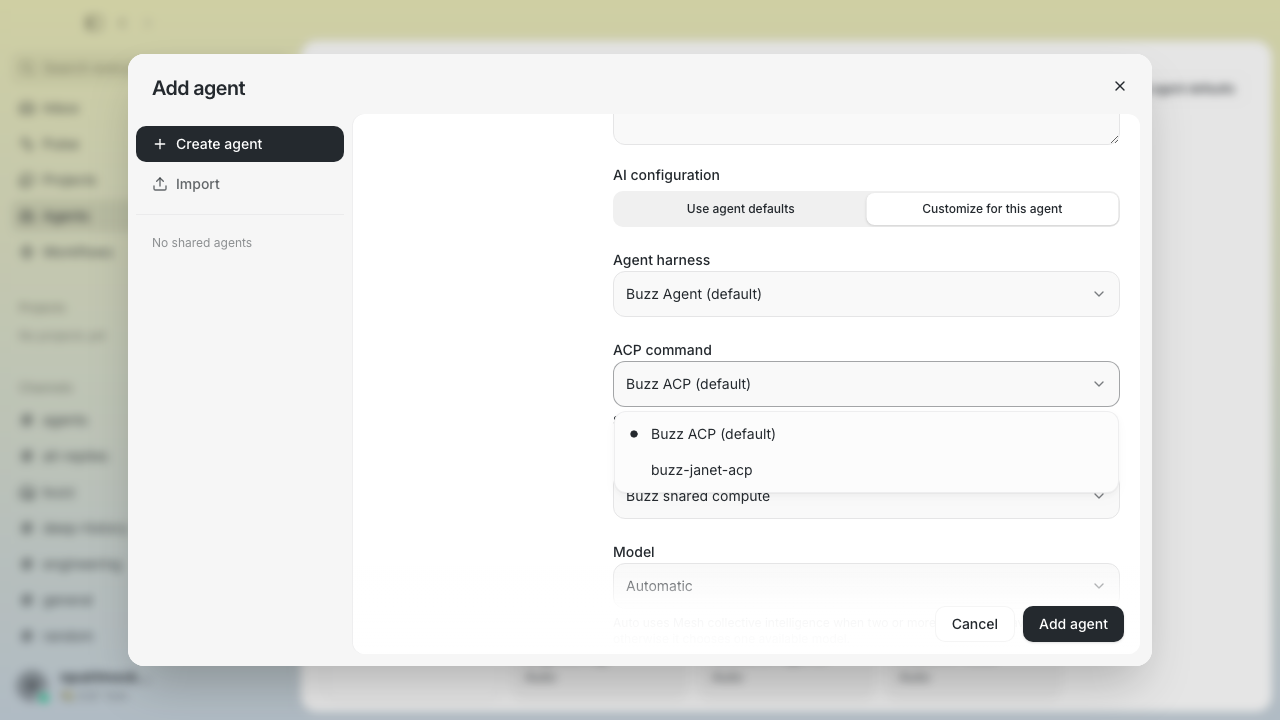 ### 3. The wrapper is selected before deployment 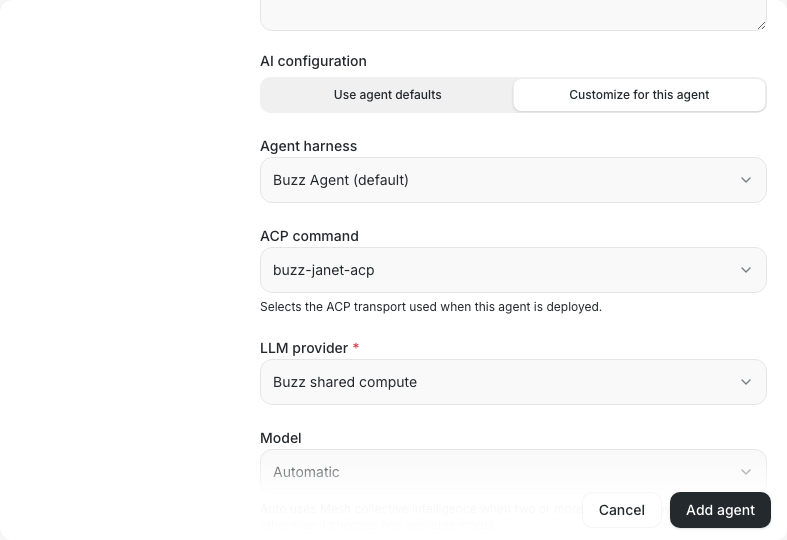 ### 4. The deployed profile reports the effective command 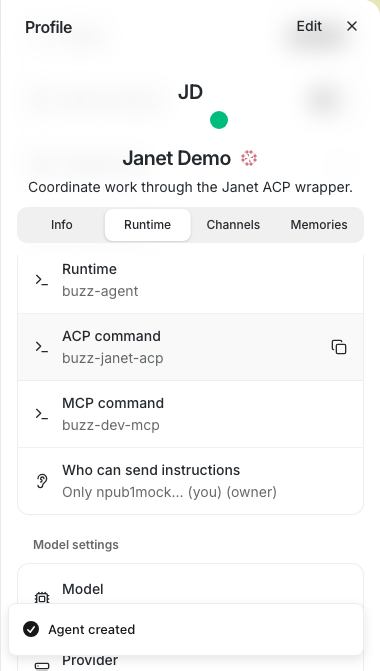 ### 5. Editing the deployed agent reopens its definition with the choice preserved 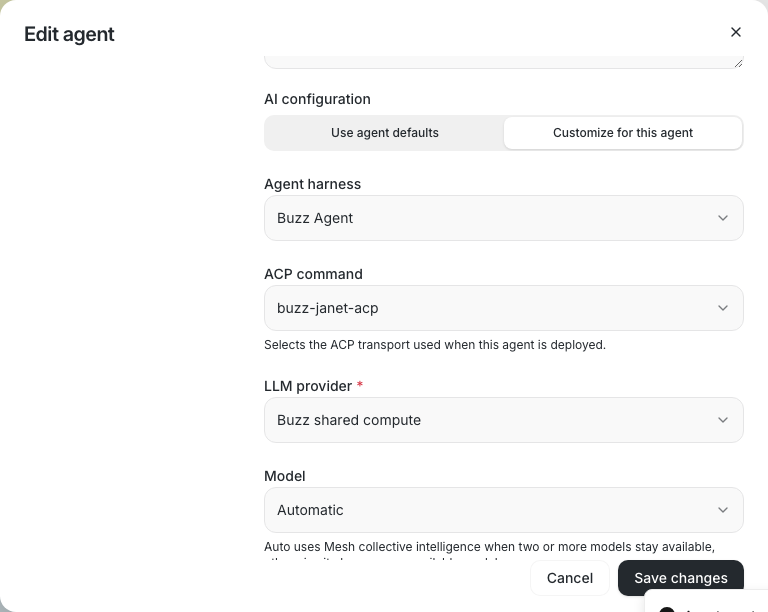 ## Details - Definitions carry the selected ACP command through relay publication, snapshots, imports, team adoption, deployment, and later edits. - Existing definitions without this field continue to use `buzz-acp`. - Unknown persisted commands remain visible but unavailable rather than being silently replaced. - Discovery is read-only and never executes candidates. It filters non-files and non-executables, supports Windows `.exe`, `.cmd`, and `.bat` shims, deduplicates aliases, and returns a stable sorted list. - Command names remain portable; Buzz does not persist machine-specific absolute paths. --------- Signed-off-by: Logan Johnson <loganj@squareup.com> Signed-off-by: Larry <8cf5a83f590ec0955b11647d1c88f796a98e088c30a492c58e0e46c3026ae7a4@buzz.block.builderlab.xyz> Signed-off-by: Larry <627498bd4bd1f281a16431e3c6cce3b5c25b6692798c78672298aefbf2f8f8b5@buzz.block.builderlab.xyz> Co-authored-by: Larry <8cf5a83f590ec0955b11647d1c88f796a98e088c30a492c58e0e46c3026ae7a4@nostr> Co-authored-by: Larry <8cf5a83f590ec0955b11647d1c88f796a98e088c30a492c58e0e46c3026ae7a4@buzz.block.builderlab.xyz> Co-authored-by: Larry <627498bd4bd1f281a16431e3c6cce3b5c25b6692798c78672298aefbf2f8f8b5@buzz.block.builderlab.xyz> | 11 天前 | |
feat(relay): implement NIP-AR channel artifacts (#7919) ## Summary Implements NIP-AR channel artifacts (spec merged in #7791) on the relay, after a simplicity pass over the earlier two-agent implementation. An artifact is an editable record (kind 45010) with a stable identity (`d`), one home channel (`h`), and full-snapshot revisions chained by `prev`: - **Writes:** one transaction per write. It locks the artifact's head row, requires `prev` to name the current revision, records the revision in a ledger that survives retention, and advances the head. Two competing edits can't both win. A stale edit gets `conflict: artifact head changed`. Resubmitting an accepted event succeeds without applying it twice. - **Permissions:** writes pass the same gates as a kind 9 message in `h`. A move also passes them in the source channel. The move stores the destination snapshot and a relay-signed kind 45011 removal marker for the source in the same transaction, so both channels recover by replay. The marker never names the destination. - **Moderation:** redaction is the ordinary kind 9005 removal. The ledger keeps the ID so `prev` checks still work. Redacting the current revision retires the artifact. - **Reads:** HTTP `/query` and `/count` accept explicit `artifact: current|history` filters with exact multi-character tag matching (e.g. `#assignee`). Generic REQ and search return only current revisions. Kind 5 against artifacts is rejected. NIP-11 advertises the limits. - **Spec:** NIP-AR updated to match: kind 9 permission checks, 9005 redaction and retirement, no creator-only delete rule. A separate small commit routes `insert_channel_head_checked` through the metered writer pool (`acquire_writer`), like every other event write in that module. ### Related issue Follows #7791. No separate issue found. ### Testing - Clippy clean. - Unit lane passes. Failures seen along the way came from agent env leaking into `buzz-acp` tests (they pass in a clean env) and known timing flakes (`keepalive_resets_idle_past_deadline`, two `buzz-agent` databricks tests that passed on retry). This diff doesn't touch those crates. - Postgres lane passes, including new `artifact_postgres_tests` in `buzz-db` and `buzz-relay`. Three presence tests need `REDIS_URL` set. - Docker smoke against a fresh local relay, 29/29: create and idempotent resubmit, update and stale conflict, current, `#assignee` and history queries, generic REQ, kind 5 rejection, delete and restore, move with source marker, private-channel isolation, and 9005 retirement. - A pasteable curl walkthrough of the same flows was shared with the reviewer. Draft until the human hands-on check (AGENTS.md step 3) is confirmed. The pre-push hook was skipped because every lane above had already run on this tree. CI is the gate. 🤖 Generated with [Claude Code](https://claude.com/claude-code) --------- Signed-off-by: Honey <8e307ae0076a4dab6b94b036ea3edc7e08f823a625269c1e6919e881a048b4d2@buzz.block.builderlab.xyz> Signed-off-by: murderbot <3754f8729004d95654c46dbab3129e4ab9ef05cc2534e2a3fbfc155983bd637b@buzz.block.builderlab.xyz> Co-authored-by: Honey <8e307ae0076a4dab6b94b036ea3edc7e08f823a625269c1e6919e881a048b4d2@buzz.block.builderlab.xyz> Co-authored-by: Claude Opus 5.5 (1M context) <noreply@anthropic.com> Co-authored-by: Smartie <fb3185faacfc3760b6b4fe0085a8878d8dd537f7a7671c7d3184fe1aa1b04df4@buzz.block.builderlab.xyz> Co-authored-by: Fizz <400e8babadcee6a7f420103f10a2849d84c4a9c71d5bd04f3948c814216648a3@buzz.block.builderlab.xyz> Co-authored-by: murderbot <3754f8729004d95654c46dbab3129e4ab9ef05cc2534e2a3fbfc155983bd637b@buzz.block.builderlab.xyz> | 7 天前 | |
feat(relay): add opt-in newest-first thread windows (#7823) ## Summary Add an opt-in, newest-first thread window to the authenticated HTTP query path. A filter with `thread_window: true` returns: - reply rows ordered by `(created_at DESC, id ASC)` with an exact composite cursor; - optional bounded reactions, edits, deletions, and delete-of-aux closure; - one relay-signed `kind:39007` bounds event bound to the normalized host, authenticated reader, channel, root, request cursor, kinds, depth, limit, and aux choice. Filters without the flag keep the existing oldest-first thread behavior. Channel windows and `kind:39006` are unchanged. No client opts into this mode in this PR. ### Why extend NIP-CW NIP-CW already defines relay-computed, cursor-paged conversation views over extended NIP-01 filters. Thread windows use the same protocol ideas: ordinary signed rows, composite keyset pagination, optional aux closure, and relay-signed bounds. Adding a thread mode keeps those related wire contracts together instead of creating a second NIP with duplicated terminology and compatibility rules. Extending a draft, optional NIP with an additive mode is normal protocol evolution. Existing fields and meanings are not reinterpreted: - `top_level: true` remains channel mode; - `kind:39006` remains channel-window bounds; - `thread_window: true` selects the new mode; - `kind:39007` has a distinct identity and root/request binding; - extension-unaware clients never send the selector; - legacy thread queries remain unchanged. NIP-CW documents only the wire contract and relay semantics. Database plans, replica internals, and rollout procedures remain implementation concerns. ### Why thread windows use independent modules The implementation deliberately keeps `thread_window.rs` separate in `buzz-core`, `buzz-db`, and `buzz-relay` rather than adding branches throughout the existing channel-window path. The modes share pagination concepts, but their invariants differ: - channel mode selects top-level rows; thread mode requires one root and depths `1..=depth_limit`; - thread mode accepts only conversation row kinds and rejects unknown/conflicting fields; - thread bounds bind the root and authenticated reader because cross-channel aux visibility can differ by reader; - thread aux includes the root and requires complete two-hop closure; - thread mode refreshes writer authorization before selection and before signing; - historical cursor pages may use a proved replica transaction, but fallback must restart both aux hops on the writer; - legacy thread traversal is oldest-first and must not inherit descending cursor semantics. Forcing these rules into channel-window code would create a mode flag across parsing, SQL predicates, bounds construction, authorization, replica fallback, and tests. That abstraction would not remove complexity. It would distribute it. Separate modules keep each contract local and leave the established channel and legacy paths untouched. ### Technical design - Strict request parsing normalizes UUIDs, event IDs, kinds, defaults, and cursors before computing the response binding. - SQL applies community, root, channel, depth, kind, deletion, and cursor predicates before `limit + 1`. - Ordered metadata scanning plus exact event-key lookup avoids the stale-statistics plan that previously exceeded the four-second SQL budget on a 10k-reply thread. - Aux work is bounded by target batches, query count, raw candidate count, response bytes, SQL timeouts, and one shared HTTP deadline. - Fresh authorization-set comparison catches both grants and revocations during closure. The relay returns retryable `503` rather than signing an incomplete page. - Replica failure permanently degrades the request to the writer and restarts closure from its original targets without resetting budgets. - Migration `0049_thread_window_index.sql` adds the mixed-direction index used by newest-first scans. It validates a prebuilt index and bounds startup lock/build time. ### Tradeoffs - The stale-statistics-safe plan is intentionally less clever. Measured warm 100k deep-cursor execution increased from roughly 0.30 ms to 4.80 ms, plus about 8 ms planning, in exchange for avoiding a reproduced multi-second timeout after rapid 10k-thread insertion. - Bounds are authoritative only for the served page. There is no cross-page snapshot guarantee, and replica insertion coverage does not imply latest edit/deletion/aux visibility. - Strict parsing rejects unsupported constraints instead of silently serving a different row set. - Required aux closure fails closed. The relay does not omit aux and sign plausible-but-incomplete bounds. - This PR ships relay capability only. Client rendering, retry UX, live-history overlap, and compatibility fallback remain separate work. ### Related issue No existing issue found. This work follows the thread-loading design and review discussion. ### Testing - `cargo test -p buzz-core`: 258 unit tests and 2 doctests passed. - `cargo check --workspace --all-targets`: passed at the rebased implementation head. - `cargo test -p buzz-db`: 131 non-PostgreSQL tests passed; 275 infrastructure tests were ignored as declared. - Focused PostgreSQL migration/runtime regressions: 3/3 passed against an isolated PostgreSQL container, including both corrected migration-ledger tests. - `cargo fmt --all --check`: passed. - Pre-rebase feature validation passed 398/398 PostgreSQL tests, signed-wire multi-tenant/auth/pagination/aux/revocation probes, clean Compose boot/reboot, and full core tests. - Independent HA validation exercised three relay pods and a physical PostgreSQL standby on the same runtime logic before the final documentation-only cleanup. - Independent final-delta review confirmed exactly two changed files, byte-identical executable migration SQL after comments/diagnostic normalization, matching prebuild/catalog/recovery instructions, and `git diff --check`; no runtime receipts were relabeled to the new SHA. - The pre-push hook ran repository checks but its Rust unit lane exited 100 without exposing an individual failed test in the captured multiplexed output. The independently run affected-package checks above passed; current-head repository CI remains required. Known unrelated baseline behavior remains: the mesh-demo echo test can return 504, and same-second archive → unarchive can deduplicate its membership notification. Neither path is changed here. --------- Signed-off-by: Kalvin Chau <kalvin@block.xyz> Signed-off-by: cid <d9f92a72922bf45c17379a47d64dae84b6020397c2d5a52b5317d512068cd9d3@buzz.block.builderlab.xyz> Signed-off-by: am <6e30cd56c30e030cd31bb0939b94a7c257c9a09d5ba2d92cf2735da45629f248@buzz.block.builderlab.xyz> Co-authored-by: cid <d9f92a72922bf45c17379a47d64dae84b6020397c2d5a52b5317d512068cd9d3@buzz.block.builderlab.xyz> Co-authored-by: am <6e30cd56c30e030cd31bb0939b94a7c257c9a09d5ba2d92cf2735da45629f248@buzz.block.builderlab.xyz> | 12 天前 | |
refactor: rename sprout backend to buzz (#958) Signed-off-by: Will Pfleger <pfleger.will@gmail.com> Signed-off-by: Will Pfleger <wpfleger@block.xyz> Signed-off-by: Will Pfleger <wpfleger@squareup.com> Signed-off-by: Will Pfleger <wpfleger96@gmail.com> Co-authored-by: npub1mn7jgtj4w2pd0g0zeuhxsa6jy6p0rewxz4kujt98my82ahfmp72sxjexk7 <dcfd242e557282d7a1e2cf2e6877522682f1e5c6156dc92ca7d90eaedd3b0f95@sprout-oss.stage.blox.sqprod.co> Co-authored-by: npub1fgdl5qqnh3k3f2xkqrvt7cujalhm623x4s7fdjdj5yrtp5fzjl9qrjpucw <4a1bfa0013bc6d14a8d600d8bf6392efefbd2a26ac3c96c9b2a106b0d12297ca@sprout-oss.stage.blox.sqprod.co> Co-authored-by: npub16v54tttfqacx9ycvc3k0ut0npj564ahcuajzy6qjvh57ntmsf4uq4806j2 <d32955ad69077062930cc46cfe2df30ca9aaf6f8e76422681265e9e9af704d78@sprout-oss.stage.blox.sqprod.co> Co-authored-by: Will Pfleger <wpfleger96@gmail.com> | 3 个月前 | |
feat(relay): add NIP-ER push scheduler with cross-pod delivery (#957) Signed-off-by: Will Pfleger <pfleger.will@gmail.com> Co-authored-by: npub1mn7jgtj4w2pd0g0zeuhxsa6jy6p0rewxz4kujt98my82ahfmp72sxjexk7 <dcfd242e557282d7a1e2cf2e6877522682f1e5c6156dc92ca7d90eaedd3b0f95@sprout-oss.stage.blox.sqprod.co> | 3 个月前 | |
🤖 docs(nip-fi): remove implementation references from the spec (#7912) This removes implementation references and implementation status from `docs/nips/NIP-FI.md` so the spec holds normative text only. It drops the Blossom compliance note, the known-gap notes, crate/file paths and PR numbers, roadmap "supersedes" sentences, doc-history lines, and the design-rationale note on session-only vs deny-until-TTL (its restart re-push SHOULD remains stated normatively elsewhere). Two wording changes carry normative weight: `PUT /media/upload` is listed as a plain kind-24242 upload route instead of a temporary alias, and the JWKS fetcher's SSRF controls become a MUST instead of a description. It doesn't depend on any enforcement PR and can merge at any time. Related: #7265 --------- Signed-off-by: Will Pfleger <pfleger.will@gmail.com> Co-authored-by: Hayt <211b96e6a2b7f45fd4047988976c7bbbeeda0c15f3ae7b32eec20834b5a55118@buzz.block.builderlab.xyz> | 7 天前 | |
docs(nips): fix stray angle brackets in created_at clauses (#4486) ## Summary The `<` in a `created_at<` condition is the comparison operator, but in three places it had been paired with a closing `>` as if it opened a `<placeholder>` bracket: - **NIP-OA** clause list: `created_at<unix-timestamp>` → `created_at<unix-timestamp` - **NIP-OA** satisfaction rule: `created_at<t>` → `created_at<t` - **NIP-GS** "Conditions in Git Context": `created_at<t>` → `created_at<t` (line 437 of the same file already used the correct form) This matches the `created_at>...` forms used alongside them, which never carried a closing bracket. Also normalizes the NIP-OA headings to ATX style and pretty-prints the signed-event JSON example for readability. ## Verification Docs-only change. The NIP-OA test vectors are untouched and were re-verified by recomputing them: the preimage SHA-256, `tag-bytes-hex`, and the signed-event `id` all still match the documented values. 🤖 Generated with [Claude Code](https://claude.com/claude-code) Signed-off-by: zmeyer44 <zmmeyer44@gmail.com> Co-authored-by: Claude Fable 5 <noreply@anthropic.com> | 6 天前 | |
docs(nips): add profile-attestation owner path to NIP-IA (#732) Signed-off-by: Tyler Longwell <109685178+tlongwell-block@users.noreply.github.com> Co-authored-by: npub1qyvc0c5kl4gqv2fd97fsk46tu378sqgy35vc83rvgfwne90sel7s0ed67d <011987e296fd5006292d2f930b574be47c7801048d1983c46c425d3c95f0cffd@sprout-oss.stage.blox.sqprod.co> Co-authored-by: Max (sprout agent) <d8473ee32b973aa31a21a65adddcc4b69cc2a8a4dee8121ecd51926e0cddbc02@sprout-oss.stage.blox.sqprod.co> | 4 个月前 | |
docs(nips): specify kind:30621 multi-repo projects (NIP-MP) (#3163) Buzz renders one card per `kind:30617`, so a project spanning several repositories has no representation — the relay, desktop app, and mobile app look like three unrelated things. This adds the spec for the container event that fixes that, plus the two shared fixture files that make it machine-checkable. Docs only; no code changes. Membership cannot live in the repository announcements themselves. A project spanning Alice's and Bob's repositories would need *both* of them to publish a tag naming the group, and Alice cannot sign for Bob's key. A project's own name, description, and channel binding likewise have no single writer when scattered across per-repository tags, and no deletion story. That is why multi-repo grouping is the one forge concept in Buzz that warrants a custom kind. ## `docs/nips/NIP-MP.md` `kind:30621`, an addressable event per NIP-01, addressed by `(pubkey, 30621, d)`. Members are `a` tags holding canonical `30617:<lowercase-64-hex-owner>:<repo-d>` coordinates, following NIP-01's 2-or-3-element grammar where the optional third element is a relay hint clients MAY use and whose content ingest does not parse. Metadata is `name`, `description`, `buzz-channel`, `buzz-visibility`. - **Authority stops at the container.** The signer can replace their own project and nothing else — no edit, delete, push, or admin over any member. Deletion additionally admits the signer's registered NIP-OA owner, because `validate_standard_deletion_event` (`crates/buzz-relay/src/handlers/side_effects.rs`) grants that platform-wide so a human can clean up events published by an agent they own; the spec documents it as a Buzz extension to NIP-09 rather than carving `kind:30621` out of it. `buzz-channel` on a project is metadata only; git push policy reads the repository's own `kind:30617` (`crates/buzz-relay/src/api/git/policy.rs`) and a project never becomes an input to it. - **Ingest validation contract**, with named rules the fixtures reference: `d-cardinality`, `d-empty`, `member-cap` (64, counting every `a` tag), `member-tag-arity`, `member-coordinate-malformed`, `member-duplicate`, `metadata-cardinality`, `metadata-length`. Arity is its own rule rather than part of coordinate parsing, because a four-element member tag can carry a valid coordinate — the tag's shape is what is wrong, and ignoring elements past the relay hint would admit unvalidated data no consumer reads. Duplicates are rejected rather than normalized — a relay cannot rewrite tags inside a signed event without invalidating its id and signature. - **Metadata interpretation is normative, not left to the reader.** Ingest bounds cardinality and length and interprets nothing; clients resolve absent `name` to the `d` value, any unrecognized `buzz-visibility` token to `listed` (a typo is not a privacy signal), and an unresolvable `buzz-channel` to a project rendered without a channel rather than dropped. `content` carries no meaning: writers SHOULD emit `""`, and readers and relays MUST ignore any value rather than reject it. - **Claim authority.** A project suppresses a member's standalone card only when it is listing eligible *and* its signer is that repository's owner or appears in the repository's own `maintainers` tag. Without this, anyone could publish a project naming your repository and pull it out of the collection into a container you never consented to. An unauthorized project still renders, and still renders its members — it just cannot remove a repository from where its owner expects to find it. - **Deterministic client fold**, seven steps, with a table of required cases: exhaustive enumeration (a fixed `limit: 200` makes repository 201 vanish), multiple membership, fallback to a standalone card, unresolvable members marked unavailable rather than dropped, and local hide of a container never hiding repositories. On a relay that provides no exhaustive mode, the conformant behavior is a persistently marked possibly-incomplete collection — not a violation of the enumeration requirement. - **Pagination is specified in two modes**, because exhaustive enumeration is not universally achievable. Both modes share an explicit three-condition relay contract: a relay must (1) apply the complete filter before enforcing any limit, (2) expose the exact effective page limit it enforces, and (3) saturate pages — return `min(effective limit, remaining matches)`, so a short page proves all remaining matches were returned. A relay satisfying any proper subset does not provide the guarantee, and absent it a client MUST mark the collection possibly incomplete. On a relay exposing a composite `(created_at, event id)` keyset cursor — Buzz does on its authenticated HTTP bridge endpoint, via `until` + `before_id`; the NIP-01 websocket REQ path silently discards `before_id`, so a websocket client against Buzz is in mode 2 — clients MUST page by it; within the relay contract the cursor's uniqueness means no skips or re-reads and a short page is an unambiguous end signal, but cursor uniqueness alone does not substitute for the relay contract. A vanilla NIP-01 filter has no id tiebreak, so `until` alone either skips a second's unread events or never advances; there a client MUST drain the boundary second explicitly. The spec also adds normative guidance on query shapes: a client MUST use only query shapes the relay applies completely before limiting, and where a needed constraint (such as `#a`) is post-applied, MUST widen to a pushable shape and match the rest client-side. - **Kind allocation** recorded with the checks performed: `30621` is unassigned in the upstream nostr NIPs kind table and has no nostrbook.dev entry, and it is the one free number between `30620` and `30622` locally. ## `docs/nips/NIP-MP.fixtures.json` The ingest contract: 31 cases — 11 accept, 20 reject — as unsigned templates consumers sign with their own test key. Coverage includes minimal and full projects, zero members, the 64-member boundary from both sides, cross-owner and same-`d`-different-owner members, colon-bearing repository `d` values, relay hints, non-empty `content`, and every rejection rule. Each of the two 256-byte `buzz-` bounds gets its own reject case so neither can hide behind the other's rejection, and duplicate detection is pinned to the coordinate alone by a case whose two identical coordinates carry different relay hints. A four-element member tag carrying an otherwise valid coordinate pins arity separately from coordinate parsing. Every rejection case names the rules that may fire, so an implementation cannot pass by rejecting a bad event for an unrelated reason. ## `docs/nips/NIP-MP.fold-fixtures.json` The fold oracle: 12 cases covering every row of the required-fold-cases table, including the discriminating case where one authorized and one unauthorized project list the same repository — an implementation that requires every listing project to be authorized emits a spurious implicit card, and one that lets any listing project suppress drops a card it owes the owner. Inputs are semantic rather than signed envelopes: a repository or project is named by its coordinate plus only what the fold reads — signer, members, `maintainers`, visibility, viewer-hidden, deletion. Every collection in `expect` is compared as a set, including each container's `members`, since the fold fixes placement and not order. Signing would re-test the ingest contract and obscure what is under test. The fold is where claim authority lives, so without a shared oracle two clients could each satisfy the prose and still render different collections from identical heads. ## `VISION_PROJECTS.md` Line 41's "zero custom kinds" now reads "no custom kind for the repo itself", with a new "One Project, Many Repos" section recording why the one exception is warranted. `30621` rows added to the kind and status tables. Related: #3171 (the `KIND_PROJECT` constant, relay ingest validation of this contract, and the inclusive `created_at <= tombstone` bound this spec's coordinate-deletion rule cites). Independent — either can merge first. --------- Signed-off-by: Will Pfleger <pfleger.will@gmail.com> | 2 个月前 | |
docs(nips): specify kind:30621 multi-repo projects (NIP-MP) (#3163) Buzz renders one card per `kind:30617`, so a project spanning several repositories has no representation — the relay, desktop app, and mobile app look like three unrelated things. This adds the spec for the container event that fixes that, plus the two shared fixture files that make it machine-checkable. Docs only; no code changes. Membership cannot live in the repository announcements themselves. A project spanning Alice's and Bob's repositories would need *both* of them to publish a tag naming the group, and Alice cannot sign for Bob's key. A project's own name, description, and channel binding likewise have no single writer when scattered across per-repository tags, and no deletion story. That is why multi-repo grouping is the one forge concept in Buzz that warrants a custom kind. ## `docs/nips/NIP-MP.md` `kind:30621`, an addressable event per NIP-01, addressed by `(pubkey, 30621, d)`. Members are `a` tags holding canonical `30617:<lowercase-64-hex-owner>:<repo-d>` coordinates, following NIP-01's 2-or-3-element grammar where the optional third element is a relay hint clients MAY use and whose content ingest does not parse. Metadata is `name`, `description`, `buzz-channel`, `buzz-visibility`. - **Authority stops at the container.** The signer can replace their own project and nothing else — no edit, delete, push, or admin over any member. Deletion additionally admits the signer's registered NIP-OA owner, because `validate_standard_deletion_event` (`crates/buzz-relay/src/handlers/side_effects.rs`) grants that platform-wide so a human can clean up events published by an agent they own; the spec documents it as a Buzz extension to NIP-09 rather than carving `kind:30621` out of it. `buzz-channel` on a project is metadata only; git push policy reads the repository's own `kind:30617` (`crates/buzz-relay/src/api/git/policy.rs`) and a project never becomes an input to it. - **Ingest validation contract**, with named rules the fixtures reference: `d-cardinality`, `d-empty`, `member-cap` (64, counting every `a` tag), `member-tag-arity`, `member-coordinate-malformed`, `member-duplicate`, `metadata-cardinality`, `metadata-length`. Arity is its own rule rather than part of coordinate parsing, because a four-element member tag can carry a valid coordinate — the tag's shape is what is wrong, and ignoring elements past the relay hint would admit unvalidated data no consumer reads. Duplicates are rejected rather than normalized — a relay cannot rewrite tags inside a signed event without invalidating its id and signature. - **Metadata interpretation is normative, not left to the reader.** Ingest bounds cardinality and length and interprets nothing; clients resolve absent `name` to the `d` value, any unrecognized `buzz-visibility` token to `listed` (a typo is not a privacy signal), and an unresolvable `buzz-channel` to a project rendered without a channel rather than dropped. `content` carries no meaning: writers SHOULD emit `""`, and readers and relays MUST ignore any value rather than reject it. - **Claim authority.** A project suppresses a member's standalone card only when it is listing eligible *and* its signer is that repository's owner or appears in the repository's own `maintainers` tag. Without this, anyone could publish a project naming your repository and pull it out of the collection into a container you never consented to. An unauthorized project still renders, and still renders its members — it just cannot remove a repository from where its owner expects to find it. - **Deterministic client fold**, seven steps, with a table of required cases: exhaustive enumeration (a fixed `limit: 200` makes repository 201 vanish), multiple membership, fallback to a standalone card, unresolvable members marked unavailable rather than dropped, and local hide of a container never hiding repositories. On a relay that provides no exhaustive mode, the conformant behavior is a persistently marked possibly-incomplete collection — not a violation of the enumeration requirement. - **Pagination is specified in two modes**, because exhaustive enumeration is not universally achievable. Both modes share an explicit three-condition relay contract: a relay must (1) apply the complete filter before enforcing any limit, (2) expose the exact effective page limit it enforces, and (3) saturate pages — return `min(effective limit, remaining matches)`, so a short page proves all remaining matches were returned. A relay satisfying any proper subset does not provide the guarantee, and absent it a client MUST mark the collection possibly incomplete. On a relay exposing a composite `(created_at, event id)` keyset cursor — Buzz does on its authenticated HTTP bridge endpoint, via `until` + `before_id`; the NIP-01 websocket REQ path silently discards `before_id`, so a websocket client against Buzz is in mode 2 — clients MUST page by it; within the relay contract the cursor's uniqueness means no skips or re-reads and a short page is an unambiguous end signal, but cursor uniqueness alone does not substitute for the relay contract. A vanilla NIP-01 filter has no id tiebreak, so `until` alone either skips a second's unread events or never advances; there a client MUST drain the boundary second explicitly. The spec also adds normative guidance on query shapes: a client MUST use only query shapes the relay applies completely before limiting, and where a needed constraint (such as `#a`) is post-applied, MUST widen to a pushable shape and match the rest client-side. - **Kind allocation** recorded with the checks performed: `30621` is unassigned in the upstream nostr NIPs kind table and has no nostrbook.dev entry, and it is the one free number between `30620` and `30622` locally. ## `docs/nips/NIP-MP.fixtures.json` The ingest contract: 31 cases — 11 accept, 20 reject — as unsigned templates consumers sign with their own test key. Coverage includes minimal and full projects, zero members, the 64-member boundary from both sides, cross-owner and same-`d`-different-owner members, colon-bearing repository `d` values, relay hints, non-empty `content`, and every rejection rule. Each of the two 256-byte `buzz-` bounds gets its own reject case so neither can hide behind the other's rejection, and duplicate detection is pinned to the coordinate alone by a case whose two identical coordinates carry different relay hints. A four-element member tag carrying an otherwise valid coordinate pins arity separately from coordinate parsing. Every rejection case names the rules that may fire, so an implementation cannot pass by rejecting a bad event for an unrelated reason. ## `docs/nips/NIP-MP.fold-fixtures.json` The fold oracle: 12 cases covering every row of the required-fold-cases table, including the discriminating case where one authorized and one unauthorized project list the same repository — an implementation that requires every listing project to be authorized emits a spurious implicit card, and one that lets any listing project suppress drops a card it owes the owner. Inputs are semantic rather than signed envelopes: a repository or project is named by its coordinate plus only what the fold reads — signer, members, `maintainers`, visibility, viewer-hidden, deletion. Every collection in `expect` is compared as a set, including each container's `members`, since the fold fixes placement and not order. Signing would re-test the ingest contract and obscure what is under test. The fold is where claim authority lives, so without a shared oracle two clients could each satisfy the prose and still render different collections from identical heads. ## `VISION_PROJECTS.md` Line 41's "zero custom kinds" now reads "no custom kind for the repo itself", with a new "One Project, Many Repos" section recording why the one exception is warranted. `30621` rows added to the kind and status tables. Related: #3171 (the `KIND_PROJECT` constant, relay ingest validation of this contract, and the inclusive `created_at <= tombstone` bound this spec's coordinate-deletion rule cites). Independent — either can merge first. --------- Signed-off-by: Will Pfleger <pfleger.will@gmail.com> | 2 个月前 | |
feat(relay): accept kind:30621 multi-repo projects at ingest (#3171) Buzz renders one card per `kind:30617`, so a project spanning several repositories has no representation. [NIP-MP](https://github.com/block/buzz/pull/3163) defines `kind:30621` as an addressable container holding a group's name, description, channel binding, and member coordinates. This adds the kind to `buzz-core` and its structural validation to the relay ingest path. ## Event shape ```json { "kind": 30621, "tags": [ ["d", "platform"], ["name", "Platform"], ["description", "Relay, desktop, and mobile."], ["a", "30617:<owner-a-hex>:buzz"], ["a", "30617:<owner-b-hex>:buzz-infra"], ["buzz-channel", "<channel-uuid>"], ["buzz-visibility", "listed"] ] } ``` ## Validation at ingest | Rule | Behavior | |------|----------| | `d` tag | exactly one, non-empty (length already bounded by the generic `D_TAG_MAX_LEN` check) | | member `a` tag arity | exactly 2 or 3 elements per NIP-01's `a` tag grammar; a 4th element has no defined meaning and is rejected | | member `a` tag coordinate | must parse as `30617:<lowercase-64-hex-owner>:<non-empty-d>` | | duplicate members | rejected on exact string match of the canonical coordinate | | member cap | 64, counted over raw `a` tags | | metadata cardinality | at most one each of `name`, `description`, `buzz-channel`, `buzz-visibility` | | metadata length | `name` ≤ 256 bytes, `description` ≤ 2048 bytes, `buzz-channel` ≤ 256 bytes, `buzz-visibility` ≤ 256 bytes | | zero members | valid | | unknown tags | ignored | Rejection order is normative so a client can predict which rule fires: `d`-cardinality → `d`-empty → member-cap → member-arity → coordinate parse → member-duplicate → metadata cardinality → metadata length. ## Design notes **No membership authorization.** Members are `a` tags, so one project may name repositories owned by different pubkeys — the entire point of the kind. That is safe because membership grants nothing: push policy reads a repository's own `kind:30617` (`api/git/policy.rs`) and never a project. `buzz-channel` is a metadata reference, not a routing directive, so projects are classified global-only. **Owner-only editing is free.** NIP-33 addressing keys replacement on `(pubkey, kind, d)`, so one signer can never overwrite another's project. No relay-side permission check exists or is needed, and `test_project_same_d_under_two_authors_are_independent` pins it. **Duplicates are rejected, not deduped.** A relay cannot rewrite tags inside a signed event without invalidating its id and signature, so the alternative to rejection is a stored duplicate-member head that every consumer must apply a first-wins rule to. **The cap is checked before the duplicate set is built.** Counting raw `a` tags rather than distinct coordinates means an event naming one coordinate thousands of times is refused on count, instead of being bounded only by the relay frame limit. **No side-effect handler.** Generic NIP-33 replacement and generic NIP-09 coordinate soft-delete already cover replacement and deletion; `kind:30621` needs no entry in `is_side_effect_kind`. ## Generic NIP-09 fix carried along `soft_delete_by_coordinate` (`crates/buzz-db/src/event.rs`) previously deleted the live coordinate head regardless of the tombstone's own `created_at`, so a delayed or replayed `a`-tag deletion signed between two versions destroyed the newer replacement. NIP-09 scopes an `a`-tag deletion to versions at or before the deletion request, so the `UPDATE` now carries `created_at <= $5` and `handle_a_tag_deletion` threads the deletion event's `created_at` through. The bug predates `kind:30621` and affected every parameterized-replaceable kind on the generic path — `kind:30617` repository announcements included — so the fix lands there rather than as a project special case. `events.created_at` is immutable per row, so the predicate guarantees a tombstone can never erase a version newer than itself; the UPDATE re-evaluates its WHERE clause after any lock wait. Under READ COMMITTED, a same-coordinate replacement racing the deletion may cause the deletion to evaluate before the new head lands, returning `Ok(false)` — but that outcome is state-identical to the deletion having arrived first, a valid Nostr ordering Nostr never fixes. The return value feeds only a debug log. No coordinate-level lock is needed. ## Coverage 32 unit tests in `crates/buzz-relay/src/handlers/ingest.rs` pin the envelope contract (accept: minimal, cross-owner, zero-member, same repo `d` under two owners, colon-bearing repo `d`, cap boundary, unknown tags, relay hint on member `a` tag, max-length metadata, stranger-owned member, uninterpreted metadata values, non-empty content; reject: every rule above plus valueless `d`/`a` tags). A fixture-driven test (`project_envelope_validates_all_shared_fixtures`) runs every case in the shared `NIP-MP.fixtures.json` oracle (11 accept + 20 reject) against `validate_project_envelope`, so any future change that breaks a case turns the test suite red. 6 `#[ignore]`d e2e tests in `crates/buzz-test-client/tests/e2e_project.rs` cover behavior that only exists past storage — coordinate round-trip, newer-wins replacement, two authors sharing a `d`, an `a`-tag tombstone that removes the project while leaving referenced `kind:30617`s intact, and a tombstone timestamped between V1 and V2 that must leave V2 live. The negative e2e case asserts on the rejection message so a refusal for an unrelated reason cannot satisfy it; that is what proves the validator is reachable from the live write path rather than merely correct in isolation. The new e2e binary is wired into the Relay E2E job. The timestamp predicate is additionally pinned at the storage layer by `coordinate_delete_spares_head_newer_than_the_deletion` in `crates/buzz-db/src/lib.rs`, which asserts both directions: a stale tombstone deletes nothing and leaves the newer head readable, and a tombstone at the head's own timestamp still deletes it. This test is wired into the Backend Integration job. Related: #3163 (the NIP-MP spec and shared conformance fixtures). Independent — either can merge first. --------- Signed-off-by: Will Pfleger <pfleger.will@gmail.com> Co-authored-by: npub1mn7jgtj4w2pd0g0zeuhxsa6jy6p0rewxz4kujt98my82ahfmp72sxjexk7 <dcfd242e557282d7a1e2cf2e6877522682f1e5c6156dc92ca7d90eaedd3b0f95@buzz.block.builderlab.xyz> | 2 个月前 | |
docs(nips): fix stray angle brackets in created_at clauses (#4486) ## Summary The `<` in a `created_at<` condition is the comparison operator, but in three places it had been paired with a closing `>` as if it opened a `<placeholder>` bracket: - **NIP-OA** clause list: `created_at<unix-timestamp>` → `created_at<unix-timestamp` - **NIP-OA** satisfaction rule: `created_at<t>` → `created_at<t` - **NIP-GS** "Conditions in Git Context": `created_at<t>` → `created_at<t` (line 437 of the same file already used the correct form) This matches the `created_at>...` forms used alongside them, which never carried a closing bracket. Also normalizes the NIP-OA headings to ATX style and pretty-prints the signed-event JSON example for readability. ## Verification Docs-only change. The NIP-OA test vectors are untouched and were re-verified by recomputing them: the preimage SHA-256, `tag-bytes-hex`, and the signed-event `id` all still match the documented values. 🤖 Generated with [Claude Code](https://claude.com/claude-code) Signed-off-by: zmeyer44 <zmmeyer44@gmail.com> Co-authored-by: Claude Fable 5 <noreply@anthropic.com> | 6 天前 | |
feat(push): support configurable HTTP(S) delivery URLs (#7877) The relay can use a configurable HTTP(S) gateway delivery URL and signs the same URL it sends. The gateway verifies NIP-98 against the received request URL, including authority, port, path and query. App Attest, scoped grants, replay checks and delivery quotas are unchanged. Forwarding proxies must preserve Host and supply the original request scheme through X-Forwarded-Proto. The NIP relay-delivery wording now defines the configured HTTP(S) URL as the signed URL and labels the public URL as an example. <!-- buzz-review-completed --> --------- Signed-off-by: Tom Brow <tomb@block.xyz> | 9 天前 | |
Define private managed agent wire protocol (#4593) ## Summary - reserve kind `30179` for owner-private managed-agent aggregates - define the fail-closed owner-self NIP-44 v2 envelope and versioned payload codec - bind runnable identity/configuration to complete signed `30175`/`30177` recovery projections - validate NIP-OA owner→agent attestations and reject self-attestation - document NIP-PMA authority, migration prerequisites, privacy, and deployment order - keep generic relay ingest closed until private storage and atomic aggregate CAS exist ## Safety boundary This is the inert protocol/codec slice only. It does not publish secrets, change agent authority, migrate local records, or enable kind `30179` ingestion. The relay regression test proves generic EVENT ingest still rejects the kind. The finalized migration plan adds later prerequisites for relay-private storage/CAS, runtime lease/fencing, Desktop cutover, and harness authentication. Those belong in staged follow-up PRs rather than expanding this inert foundation. ## Validation At commit `67f0ea4ebb8d3ccba3a3eb9374e89a7178913f74`: - `cargo test -p buzz-core` — 246 unit + 2 doc tests passed - `cargo test -p buzz-relay private_managed_agent_kind_remains_rejected_until_atomic_ingest_exists` — passed - push hooks: Rust tests and desktop checks passed (`2145` desktop tests passed, `14` ignored) - `cargo fmt --all -- --check` - `git diff --check` ## Review Princess Donut cleared security/data integrity with no remaining high/medium findings. Mongo cleared migration compatibility and wire grammar. The later runtime lease/fencing protocol was also adversarially cleared as a plan; implementation slices still require independent evidence before activation. Deterministic plaintext/signed-projection/auth-tag interoperability vectors remain a valuable follow-up, not an S0 merge gate; random NIP-44 ciphertext is intentionally not snapshotted. --------- Signed-off-by: Wes <wesbillman@users.noreply.github.com> Co-authored-by: Carl <c7ebe626f000404285d3686e1dc74cc07cc60a9754a150041ba132e14bd3e2ec@buzz.block.builderlab.xyz> | 1 个月前 | |
feat(relay): add atomic complete read-state snapshots (#7572) Opened by Brain on behalf of Wes (GitHub: wesbillman). ## Summary Add an opt-in, host-scoped completeness primitive for NIP-RS read-state clients. Ordinary query arrays and WebSocket behavior remain unchanged. - Advertise a version-1 `read_state_snapshot` capability in NIP-11 only when the request resolves a community. - Accept exactly one self-author kind-30078 snapshot filter on authenticated `POST /query`, after the existing admission, replay and membership gates. - Read all retained, nondeleted self-author kind-30078 coordinates from the writer at one SQL-statement MVCC cut—including unrelated application coordinates and events without a read-state tag. - Return a complete versioned envelope bound to community, signer and a content-identity hash. Reject malformed contracts, reconstruction/signature/storage failures and whole-request overflow; never return a truncated complete response. - Bound snapshots at 4,096 events and 8 MiB of compact encoded event-array bytes, advertised as `max_event_array_bytes`; envelope metadata is additional. Retain the separate stored-payload preflight budget. ## Safety and scope This is point-in-time enumeration, **not** a live freshness guarantee, cursor, CAS token, cross-relay transaction, or unread total. NIP-RS now explicitly requires fresh complete enumeration from every write relay before each override action, canonical publication, carry-forward or deletion. It does not enable synchronized manual-unread overrides in any client. No schema migration or deployment is included. ## Validation Executed against the source committed as `1fd5a5e0c0d893c1259386885517c0c44ae7630f`: - Four real-router/PostgreSQL snapshot cases: beyond-page-cap enumeration and overflow; corruption/storage failure; production payload-bound NIP-98, Redis replay guard and membership enforcement; host discovery/scope/strict request shape. - Two database cases: replacement during preflight preserves a single statement cut; encoded-byte overflow and writer-not-replica routing. The cluster-wide probe uses the required `cluster_global_` serialization prefix. - Production-call-site mutations killed for dispatch, strict filter validation, discovery tenant, snapshot tenant, encoded-byte guard, membership enforcement and replay enforcement; isolated mutation tree restored. - Both affected crates pass all-target Clippy; formatting, differential file-size and repository PostgreSQL test-discovery checks pass. - Normal pre-push gates pass without bypass: branch skew, push-head scope, file size, Rust unit lanes and desktop Tauri checks. - Independent read-only review by Pinky found no remaining relay blocker at this commit. The execution/mutation results above were run by Brain, not duplicated by the reviewer. Hosted CI and maintainer review remain separate gates. No production traffic or deployment was used for these fixture tests. Originating Buzz channel: `a394ecdb-9c67-4c4e-a3c6-4a95f69e8cc8` (unread-but-good), thread `2413d0ba7fa5b2ac5c777df6b3754e2099b042ec8fb96ca64302a0919a0550b3`. ## Review repair (2026-09-21) Carl updated this existing branch to `2f9c9b11266c24947412cf28cefae4e96e7167b7`, merging main `5079c770fe30bb3d8204822ce6c2431eacac6d4b` without rewriting published history. - Resolved the DB export conflict, preserving both snapshot and storage-accounting exports. - Addressed the blocking review using its accepted alternative: rename `max_bytes` to `max_event_array_bytes` and explicitly document that success-envelope metadata is outside the array budget. No auth, query, runtime-limit, or client-behavior redesign. - Added a PostgreSQL/router regression proving discovery, exact 8,388,608-byte array success with a larger envelope, and one-byte-over rejection (413, no partial complete response). Exact-head validation: all seven snapshot PostgreSQL/router tests passed in an isolated local database; both affected crates passed all-target Clippy; mandatory pre-commit/pre-push gates passed without bypass (Rust unit lanes, Tauri default/mesh Clippy and tests, differential file size, branch-skew/ref checks). Reverting only the descriptor rename made the new regression fail before the final commit. Independent bounded source-delta review by Mordecai found no blockers; execution was Carl's. A broader `cargo test -p buzz-db -p buzz-relay --all-targets` run on the merged candidate passed 131 DB tests and 1,057 relay tests, then encountered the same unrelated `mesh_demo::demo_join_forwarded_arm_round_trips_echo` 504 recorded in the prior review. Full repository `just ci` / `just test` were not rerun locally; hosted CI remains a separate gate. No deployment or production traffic was exercised. --------- Signed-off-by: Brain <1a02c72794dcd0f07058a353bc3a81f4028b8c77c92c87fce6d5c8b85970a20b@buzz.block.builderlab.xyz> Signed-off-by: Carl <32a2e2c9d428ee08902cab75d956da2c1d235a22d4766b0dd4138bf6e2e5db1d@buzz.block.builderlab.xyz> Co-authored-by: Brain <1a02c72794dcd0f07058a353bc3a81f4028b8c77c92c87fce6d5c8b85970a20b@buzz.block.builderlab.xyz> Co-authored-by: Carl <32a2e2c9d428ee08902cab75d956da2c1d235a22d4766b0dd4138bf6e2e5db1d@buzz.block.builderlab.xyz> | 14 天前 | |
feat: per-community workspace icon set by admins, served via NIP-11 (#1463) Signed-off-by: Wes <wesbillman@users.noreply.github.com> Co-authored-by: Brain <21994759fc7a6fa6b965551d35cfd7897d262f2495467f2d78694ddcfa6a5c7e@sprout-oss.stage.blox.sqprod.co> | 3 个月前 |
| 文件 | 最后提交记录 | 最后更新时间 |
|---|---|---|
| 5 个月前 | ||
| 4 个月前 | ||
| 2 个月前 | ||
| 5 个月前 | ||
| 11 天前 | ||
| 7 天前 | ||
| 12 天前 | ||
| 3 个月前 | ||
| 3 个月前 | ||
| 7 天前 | ||
| 6 天前 | ||
| 4 个月前 | ||
| 2 个月前 | ||
| 2 个月前 | ||
| 2 个月前 | ||
| 6 天前 | ||
| 9 天前 | ||
| 1 个月前 | ||
| 14 天前 | ||
| 3 个月前 |