| 文件 | 最后提交记录 | 最后更新时间 |
|---|---|---|
feat(cases): add persistent workflows with same-task agent handoffs (#16959) ## Thinking Path > - Paperclip manages AI agents and their work. > - An agent workflow needs persistent facts and a safe way to transfer work. > - Creating a task for each phase splits the objective, discussion, workspace, and review policy. > - A case can retain the facts while one primary task moves between agents. > - Transfers must survive process failure and preserve private access, budgets, and completion gates. > - This pull request adds durable case handoffs, native case tools, and read-only case pages. > - Prompts describe the workflow. Existing task controls decide when work can run and finish. ## Linked Issues or Issue Description **Problem or motivation** Prompt-driven agent teams need a persistent record that can move through triage, implementation, verification, and correction. Ordinary reassignment does not provide a durable instruction, safe release barrier, or recoverable delivery receipt for an agent handing off its own running task. **Proposed solution** Extend standalone cases with one primary task, a descriptive phase, retained access sources, and a handoff ledger. Apply assignments after source execution and workspace settlement. Deliver each transfer through the existing durable wake queue. Provide `create_case`, `read_case`, `update_case`, and `handoff_case` in the native runner. Creation requires kickoff and explicit workflow text. An explicit handoff to `done` closes the case when normal task completion is accepted. **Alternatives considered** Do not add a workflow engine, filesystem queue, configured state graph, or one task per phase. The workflow document combines transition prose with an optional Mermaid `stateDiagram-v2` map. The server does not execute the diagram. The Pipelines experiment removed on master stays removed. **Roadmap alignment** This extends Agent Reviews and Approvals, Enforced Outcomes, Bounded Run Recovery, and Activity Log attribution. Existing approval, review, budget, privacy, workspace, and responsible-user rules remain authoritative. Related work: [ordinary handoff wake recovery](https://github.com/paperclipai/paperclip/pull/15019). This feature adds a separate persisted case-handoff receipt and release barrier. ## What Changed - Add case routing fields, retained access sources, durable handoff history, delivery leases, and replay-safe migrations. - Keep the same primary task across agent phases. Preserve each returning agent's own session and the task's workspace. - Fence outgoing mutations, wait for provider and workspace release, and recover delivery without duplicate task comments or runs. Recheck current assignment permissions as the original caller before applying a delayed transfer. Scope a run Stop to that run’s own handoff intents, so repeated old Stop requests preserve newer work. Cancelling terminal intent without a source run also requires fenced current task ownership, including native retries and preparation with an old checkout. For Cloud callers, revalidate current stack membership with an uncached Cloud RPC and derive owner elevation from the current managed setting. - Keep case reads, documents, assets, Audit, and live events inside retained task/project permissions. - Add native case creation/read/update/handoff tools. Store required workflow text and initial documents on the first task. Page oversized case facts and referenced document bodies through the dedicated tool with bounded UTF-8 JSON, current routing versions, snapshot conflicts, and current source authorization on every page. - Add read-only case lists and detail pages, task-style list controls, compact dotted field tables, linked handoff tasks, and case filters in Audit. - Add native/legacy integration tests, migration/restart tests, browser coverage, and bounded live receipt fixtures. Extend the trusted sandbox condition to cover the new subscription fixture profile. - Hide obsolete paused-agent warnings on completed or cancelled task threads. - Synchronize the company-switch settings test with React effects after a CI failure. Preserve its security assertions and production remount behavior. ## Verification The branch directly includes master `9ef434fe79`. The required `ci / verify` and `ci / e2e` gates pass on head `765fccd67c`. [Current-head CI](https://github.com/paperclipai/paperclip/actions/runs/39464348614) passes typecheck, build, tests, and all eight browser shards. Security checks pass. [Greptile gives this exact head 5/5](https://github.com/paperclipai/paperclip/pull/16959#issuecomment-6291156549), with no unresolved review threads. The optional Paperclip Review check remains queued because its assigned agent is paused. It is not a required branch check. No check result was overridden. Local workspace typecheck and build pass after the master merge, along with database migration checks, token gates, map checks, Storybook catalog checks, and the Copilot profile identity check. Standard builds refresh Runner vendor output. Focused checks pass 2,008 API/paging/context tests and 7 strict case protocol tests. The final commit changes one test fixture only; its ten tests, UI typecheck, and token gates pass. No production source changed in that commit. On current head `765fccd67c`, all **194 critical workflow tests** executed and passed with no skipped tests in those files: - 38 Stop/ownership tests, including board completion intent, native retries, stale Stop, and preparation with an old checkout. - 2 actual legacy process/HTTP handoff tests, including scratch failure, a closed-stdio child that continues writing, and recovery through a fresh worker after the process group stops. - 5 migration tests, including SQL column metadata, preserved null authority context, and all six prior-numbering receipts. - 3 process-settlement and 5 scratch tests. - 88 handoff-service, 18 heartbeat handoff, and 21 native case-tool integration tests. - 7 bounded case/document-read projection tests and 7 strict protocol-contract tests. The current CI checkout was `fed65d49`, merging `765fccd67c` into master `9ef434fe79`. Its new document regressions reconstruct exact Unicode/escaped bodies and revisions through real native authority and authenticated HTTP with generic API tools disabled. They cover case-owned, primary-task, and linked-task documents; routing on every page; stale document snapshots; access loss and unlinking; unrelated/foreign/private sources; system documents; and quarantined content. Active-task document tools retain their existing behavior. These are current-head test results from the first CI attempt; the browser-only retry did not rerun these suites. The full `64fdd3403f` CI failed one separate settings test: after a company switch, it observed an unsettled API-key draft. The production component and test were unchanged from prior green source. Production switches remount both keyed settings layers; the test directly reused an unkeyed view and used a timer tick instead of waiting for React effects. The final commit replaces that fixture synchronization with React `act`. The exact secret-clearing assertions and all timeouts remain unchanged. The original assertion failure remains recorded; no unchanged retry was used. The narrow unchanged baseline and fixed fixture each pass 10 tests. The upstream result-paging merge preserves case capture namespaces and current asset privacy. Its API integration suite executed 39 of 41 tests successfully, with two skipped; the optional assigned-result PRP integration test was skipped. Neither skipped suite is counted in the 194 critical tests or as live provider proof. All 361 upstream migration entries and SQL bodies remain unchanged. Six case migrations follow master as 0363–0368 with identical SQL hashes. Official Drizzle generators produced the combined metadata and five retained snapshots. Generation reports no schema changes, and the snapshot drift test passes. The earlier `ce361ae5d0` CI passed on attempt 1, including its then-current 179 critical tests. Fresh review later identified unusable document references with generic API tools disabled; the bounded document reads and ten additional authenticated HTTP tests address that finding. The full local `pnpm test:run` attempt was cancelled after this Mac exhausted PostgreSQL semaphore capacity; it is **not** counted as a pass. Later database attempts also stopped before assertions or skipped, including one sandbox socket denial. Two original stale-Stop regressions did reproduce the bug against the old source. A REST serialization assertion passed after two preserved database-startup failures. No test timeout was increased. All 194 assertions listed above executed and passed in current-head CI. The complete 385-file, 3,963-test UI shard also passed after the fixture repair. A configured-provider receipt workflow passed 13 backend checks across triage → implementation → verification → correction → done, using one task and four work runs. The saved receipt is revision 2 with total 6 USD; case and task both closed. The original canonical attempt remains failed because its browser assertion confused the terminal destination with completed-task tooltips. The corrected full browser verifier passed on the same retained database and original runs, with no additional provider calls. The last clean-build browser readback is on `6a86c54a53`; later changes affect recovery, authorization, bounded reads, and settlement. Accounted work cost is a $1.010574 rate-card estimate; provider billing and setup-probe usage are unavailable. Copilot profile 49 passed the unchanged seven-fixture private protocol pack (46/46 checks, no retries) and the product file-edit canary after master's completion-replay change. All 60 bound implementation hashes remain unchanged on the current source. Historical profile-47/48 identities and results remain intact. See the [profile-49 compatibility record](https://github.com/paperclipai/paperclip/blob/codex/persistent-case-handoffs/doc/plans/2026-10-20-copilot-completion-recovery-compatibility-v49.json). This is bounded compatibility evidence, not a fresh full matrix, installed-package product test, or Daytona rollout. Preserved CI failures and retries: - On `20662930ac`, Slack managed setup failed a five-second success assertion after reload. Its test/application path was unchanged from a prior green head. One unchanged-source retry passed all 25 tests in that shard; no source or timeout changed. - On `9402b4f17a`, two CI workers received shutdown signals at 15:24:19 UTC. Neither log had an assertion failure before interruption. One unchanged-source retry of each passed all Runner static checks and all 32 tests in browser shard 6; both aggregates passed. The next head, `7b4374edaf`, passed all CI without retries. - On `295f289b5a`, serialized shard 9 timed out during its first device-login test, then the next test found an active login lease. Direct login/test paths were unchanged from a prior green head. Cold import plus a timed-out async body using the next test's mutable actor/store is the supported fixture-race explanation; no request trace proves that sequence. The original failure remains recorded. One unchanged-source retry passed all 294 tests in 19 files, including all 41 device-login tests. No login source or timeout changed. The subsequent `ce361ae5d0` CI passed without retries. - On `64fdd3403f`, one company-switch settings assertion observed an unsettled draft. The final test-only commit uses React `act` without changing assertions, timeouts, or production code. On `765fccd67c`, all ten settings tests and the complete 385-file, 3,963-test UI shard passed. - On `765fccd67c`, browser shard 3 completed the split-handoff assertions, then cleanup received HTTP 500 from run cancellation after a one-second PostgreSQL row-lock timeout. The extra chat run was reporting completed work while teardown began. Cleanup stopped before restoring a global experiment flag, causing a later assertion to fail. Relevant production and test paths are unchanged from an earlier green commit. Stop's lock order is consistent, and no nested self-lock was found; the exact PostgreSQL blocker was not recorded. One unchanged-shard retry passed. The original failure, trace, and downstream flag failure remain recorded. No Stop implementation, cleanup assertion, or timeout changed. The retry supports intermittent cleanup contention; it does not identify the original blocking transaction. ## Risks - Local process transfers require host-owned PID/group absence. Missing or uncertain termination evidence keeps delivery pending, independently of scratch setup. - Handoff admission and task cancellation share execution ownership. New regression tests cover temporary holds, late source writes, and uncertain provider termination. - Retained private sources use an intersection of existing permissions. This intentionally fails closed when a source is missing or an existing task cannot preserve that boundary. - Migrations add tables and indexes. They preserve master history and can replay over prior feature installs. Migration 0368 adds nullable internal authorization provenance with no default or authority backfill. Historical transfers still awaiting release without this context fail closed; an operator must cancel them and request a new handoff. - Delayed Cloud handoffs depend on the current Cloud membership RPC. An unavailable, ambiguous, expired, or mismatched response holds the handoff for retry; it does not reuse cached authority or grant access. - Bounded reads reload and reauthorize the selected projection per page. Underlying work grows with the data size and number of pages. Changed data or routing requires restarting from offset zero without the old snapshot. - Phase names and workflow diagrams remain advisory. They do not satisfy review or approval gates. - This is a large, cross-cutting PR. The maintainer requested one PR for the whole feature; the commits separate data, runtime, UI, and qualification work. ## Model Used OpenAI Codex, GPT-6 family, with tool use, code execution, and delegated code review. The exact deployment model ID and context-window size were not exposed in the session. Live fixture agents used the explicitly configured provider model recorded in their test evidence. ## Checklist - [x] I have included a thinking path that traces from project context to this change - [x] I have specified the model used (with version and capability details) - [x] I have checked ROADMAP.md and confirmed this PR does not duplicate planned core work - [x] I have searched GitHub for duplicate or related PRs and linked them above - [x] I have either (a) linked existing issues with `Fixes: #` / `Closes #` / `Refs #` OR (b) described the issue in-PR following the relevant issue template - [x] I have not referenced internal/instance-local Paperclip issues or links (only public GitHub `#NNN` / `github.com/paperclipai/paperclip` URLs) - [x] My branch name describes the change (e.g. `docs/...`, `fix/...`) and contains no internal Paperclip ticket id or instance-derived details - [x] I have run tests locally and they pass - [x] I have added or updated tests where applicable - [x] I have updated relevant documentation to reflect my changes - [x] I have considered and documented any risks above - [x] All Paperclip CI gates are green - [x] Greptile is 5/5 with no open P2s, recommendations, or follow-ups - [x] I will address all Greptile and reviewer comments before requesting merge --------- Co-authored-by: Paperclip <noreply@paperclip.ing> | 3 天前 | |
feat: add kimi-local adapter for Kimi Code CLI (CLI + ACP engines) (#9967) ## Thinking Path > - Paperclip is the open source app people use to manage AI agents for work > - Local agent adapters (`claude_local`, `gemini_local`, `grok_local`, …) are the integration surface that lets Paperclip run coding CLIs on the host machine > - The Kimi Code CLI (`kimi`, Moonshot AI) has a documented non-interactive mode, `kimi -p --output-format stream-json` with session resume via `kimi -r`, but Paperclip has no built-in adapter for it > - So Kimi users (especially Kimi membership / OAuth subscribers) cannot onboard their CLI to Paperclip agent teams > - This pull request adds a complete built-in `kimi_local` adapter (both execution engines, session management, instructions + skills delivery, thinking-effort control, environment test, UI and CLI modules, docs) following the established `gemini_local`/`grok_local` package pattern > - Kimi Code ships an ACP server (`kimi acp`), so the adapter runs on Paperclip's shared acpx engine by default (streaming transcript with live tool status, like `claude_local`/`gemini_local`) and falls back to a headless CLI lane (`kimi -p --output-format stream-json`) when ACP prerequisites are unavailable > - The benefit is that Kimi Code becomes a first-class Paperclip agent lane: selectable in the UI, resumable across heartbeats, with the same operating context (instruction bundle, skills, effort) and streaming transcript the other local adapters get ## Linked Issues or Issue Description - Supersedes #9880 (same branch; expanded from the CLI-only lane into a complete adapter with the default ACP engine lane, control-plane skill install, and live transcript wiring) - Refs #9879 (adapter request for Kimi Code CLI, filed with this PR) - Refs #163 (original Kimi support request) Duplicate/related prior PRs, per the dedup search (both appear stale: no updates or maintainer review since May 2026, and both target an older Kimi CLI interface; calling them out for reviewer context per CONTRIBUTING.md): - Refs #6276 (`feat: add kimi-local adapter`): targets an older array-based content format (`{type: think}`/`{type: text}` blocks), not the current documented stream-json schema - Refs #5202 (`feat(adapter): add Kimi CLI local adapter with Wire protocol support`): builds on a `--wire` JSON-RPC interface that current Kimi Code CLI (0.27.0) no longer documents; the current documented headless interface is `-p --output-format stream-json` This PR is a fresh implementation against current master and the currently documented/verified Kimi CLI behavior (see Verification). Happy to fold in anything useful from the earlier attempts if a reviewer prefers. ## What Changed - **New adapter package** `packages/adapters/kimi-local` (`@paperclipai/adapter-kimi-local`), modeled on `gemini-local`/`grok-local`: - `src/server/execute.ts`: spawns `kimi -p <prompt> --output-format stream-json` (argv array, no shell), `-m <model>` only when configured, `-r <sessionId>` when the stored session cwd matches the run cwd, automatic fresh-session retry on unrecoverable-session errors, headless-safe env (`CI=1`, `NO_COLOR=1`, `KIMI_CODE_NO_AUTO_UPDATE=1`, `TERM=dumb`; user-configured values win), full remote (ssh/sandbox) execution lane with runtime install via `@moonshot-ai/kimi-code` - **Instruction bundle delivery**: the prompt path directive now names the sibling instruction files (`./HEARTBEAT.md`, `./SOUL.md`, `./TOOLS.md`) alongside the prepended entry file, and local runs pass `--add-dir <instructions-dir>` so Kimi can actually open them (matching `claude_local`). Without this, only the entry file reached Kimi and agents improvised the operating workflow that `HEARTBEAT.md` documents - **Thinking effort**: a configured `effort` is forwarded as the `KIMI_MODEL_THINKING_EFFORT` operational override (Kimi has no per-invocation effort flag). It is only sent for models that advertise `support_efforts` (currently `kimi-code/k3`) to avoid provider rejections, and `medium` maps to `high` since Kimi has no medium tier (`low`/`high`/`max` pass through) - **Skills delivery**: desired Paperclip skills are delivered via Kimi's `--skills-dir` flag from a dedicated per-run directory (a local snapshot, or the synced snapshot on remote targets), so skills load reliably and in isolation. Paperclip never overwrites the shared `$KIMI_CODE_HOME/skills` home, so skills installed by the operator or other agents are left intact. `--skills-dir` is only passed when at least one skill is desired, so unconfigured agents keep Kimi's default skill discovery - **Live run status**: the adapter now forwards each streamed stream-json line to `onEvent` (assistant `content` as an assistant snippet, `tool_calls` as tool-name events), which drives the issue-thread activity indicator (`currentToolName` / `lastAssistantSnippet` / `lastEventAt`). Previously the adapter only wrote the raw run log, so the issue thread showed a stale "no output for N s" line with no tool or reasoning context while Kimi worked. Tool results are omitted so the last meaningful "Using X" / snippet is not overwritten by a generic label - `src/server/parse.ts`: parses the verified Kimi stream-json event shapes (`assistant` text, `assistant.tool_calls` with JSON-string arguments, `tool` results, trailing `meta.session.resume_hint` for session-id capture) plus failure classifiers (`kimi_auth_required`, transient network, unrecoverable session). A signaled exit (null exit code, not a timeout) is now reported as a failure rather than coalesced to success, and the error message names the terminating signal - `src/server/skills.ts`: lists/syncs Paperclip skills for the adapter's skill-management surface - `src/server/test.ts`: environment test covering CLI resolution + `kimi --version`, cwd check, auth detection (OAuth credential dirs, keyed `[providers.*]` in config.toml, or the `KIMI_MODEL_NAME` + `KIMI_MODEL_API_KEY` env pair), and a live hello probe - `src/ui/` (stdout-line parser for transcripts, config builder) and `src/cli/` (stream event formatter) modules - Root metadata: three managed model aliases (`kimi-code/kimi-for-coding`, `kimi-code/kimi-for-coding-highspeed`, `kimi-code/k3`), effort-capable-model metadata (`EFFORT_CAPABLE_MODELS`, effort mapping helpers), `agentConfigurationDoc` - Tests: 101 tests across parse, execute (args building, resume gating, retry, auth error code, timeout, signaled-exit failure, effort forwarding/gating/mapping, `--add-dir` instructions directive, `--skills-dir` gating, `onEvent` runtime-event forwarding), ACP engine (engine resolution, acpx config build, node-version gate), ACP transcript delegation, environment test, UI parse/build-config - **ACP engine lane (default)** (`src/server/acp.ts` + shared `adapter-utils/acpx-engine`): Kimi Code ships an ACP server (`kimi acp`), so `kimi_local` now runs on Paperclip's shared acpx engine by default, matching `claude_local`/`codex_local`/`gemini_local`. The issue-thread transcript streams live (assistant text deltas, tool calls with a `pending`->`completed` status lifecycle) instead of the CLI lane's bursty complete-message output. Registered `kimi_local -> "kimi"` in `ACPX_ADAPTER_AGENT_IDS` and resolved the built-in agent command to `kimi acp`; `execute.ts` dispatches to the ACP executor first with an automatic CLI fallback when ACP prerequisites fail (`engine=acp` requires ACP, `engine=cli` pins the headless lane); `index.ts` falls back to the shared acpx session codec; the UI/CLI delegate `acpx.*` events to the shared acpx transcript parser and event formatter. The headless CLI lane (above) remains as the fallback - **Registration** (one entry each, mirroring existing adapters): server adapter registry + `BUILTIN_ADAPTER_TYPES`, `AGENT_ADAPTER_TYPES` (shared), UI adapter registry + display registry (`Kimi Code`, Moon icon) + capabilities defaults, CLI adapter registry, `Dockerfile` (package copy + `npm install --global @moonshot-ai/kimi-code@latest`), `vitest.config.ts` workspace, `scripts/release-package-manifest.json` - **Behavioral sets** mirroring `gemini_local` (Kimi resumes sessions the same way): `GIT_SENSITIVE_LOCAL_ADAPTER_TYPES`, `SESSIONED_LOCAL_ADAPTERS` (heartbeat + recovery), `REMOTE_MANAGED_ADAPTERS`, ssh/sandbox execution-target allow-lists, `ADAPTER_DEFAULT_RULES_BY_TYPE` (`timeoutSec: 0`, `graceSec: 15`), and `LEGACY_SESSIONED_ADAPTER_TYPES` + `ADAPTER_SESSION_MANAGEMENT` in adapter-utils - **UI touch-points**: New Agent default-model branch, AgentConfigForm command map (`kimi_local: "kimi"`) + model defaults + a Kimi-specific thinking-effort option list (`Low`/`High`/`Max`, reflecting Kimi's tiers rather than borrowing Claude's), OnboardingWizard (command map, model default, `kimi login` / `KIMI_MODEL_NAME + KIMI_MODEL_API_KEY` auth hints, manual-debug command line), InviteLanding enabled adapters - **Control-plane skill install** (`cli/src/commands/client/agent.ts`): `paperclipai agent local-cli` seeded the Paperclip control-plane skills into `~/.codex/skills` and `~/.claude/skills` so Codex/Claude agents auto-discover the API reference every run. Kimi had no equivalent target, so `kimi_local` agents began each session without the control-plane skill and rediscovered routes (e.g. the company-scoped `POST /api/companies/{companyId}/issues`) by trial and error. Added `~/.kimi-code/skills` (honoring `KIMI_CODE_HOME`) as a third install target for parity. Independent of the per-run `--skills-dir` delivery, which only applies to explicitly configured skills. - **Docs**: `docs/adapters/kimi-local.md` (prerequisites, auth options, config fields including `effort`, session resume, instruction bundle, skills delivery, control-plane skill install) + a row in `docs/adapters/overview.md` Out of scope (deliberately): model profiles, built-in agent `allowedAdapterTypes` additions. ## Verification\n\nCurrent-master rebase verification (OpenAI Codex, 2026-08-03): 13 focused files / 231 tests pass; adapter-utils, server, UI, CLI, and Kimi adapter typechecks pass; full repository build and UI token gates pass. The branch is conflict-free against master at head `1249df117c5e12e5771b9a570a6340866450619e`.\n\nAutomated (all from repo root, pnpm 9.15.4, Node 22): - `vitest run packages/adapters/kimi-local`: 89/89 pass (includes coverage for the instruction `--add-dir` directive, effort forwarding/gating/mapping, `--skills-dir` gating, the signaled-exit failure path, and `onEvent` runtime-event forwarding with cross-chunk line buffering) - `vitest run server/src/__tests__/adapter-registry.test.ts server/src/__tests__/adapter-routes.test.ts server/src/services/heartbeat-stop-metadata.test.ts ui/src/adapters/adapter-display-registry.test.ts`: 37/37 pass - `vitest run cli/src/__tests__/skills.test.ts`: 13/13 pass (the control-plane skill install target follows the existing Codex/Claude install path, whose symlink logic is unchanged) - `vitest run packages/shared`: 307/307 pass; `vitest run packages/adapter-utils`: pass except one pre-existing, unrelated failure (`mcp-isolation.integration.test.ts` requires Claude CLI ≥ 2.1.207; host has 2.1.185, fails identically on unmodified master) - `pnpm --filter @paperclipai/adapter-kimi-local typecheck|build`, plus typecheck of `server`, `ui`, `cli`, `adapter-utils`: all clean - `pnpm install --frozen-lockfile`: passes (the PR diff itself contains no lockfile changes, per repo policy; verified against a locally regenerated lockfile) - `node scripts/check-no-git-push.mjs` and `node scripts/check-forbidden-tokens.mjs`: pass - CI note: the `policy` job's release-bootstrap step is expected to stay red until a maintainer bootstraps the first npm publish of `@paperclipai/adapter-kimi-local`; see the CI Note for Maintainers comment. All other contributor-actionable checks are green. Manual end-to-end (real Kimi CLI 0.27.0, OAuth login, dev server on an isolated instance): 1. Server `GET /api/adapters` lists `kimi_local` as builtin with correct capability flags; models endpoint returns the three Kimi models 2. `POST .../adapters/kimi_local/test-environment`: all checks pass, including a live `kimi -p` hello probe 3. Created a `kimi_local` agent and invoked two heartbeats: run 1 spawned `kimi -p ... --output-format stream-json`, Kimi used its `Read` tool, produced the expected answer, and the session id was captured from the `session.resume_hint` meta event; run 2 resumed the **same** Kimi session (`sessionIdBefore == sessionIdAfter`) via `-r` 4. UI: adapter appears in the New Agent dropdown; selecting it shows the Kimi command placeholder, the three models, and the Kimi config fields; the run transcript renders Kimi tool calls via the adapter's stdout parser The instruction-bundle, thinking-effort, and `--skills-dir` changes landed after the manual run above. They are covered by the unit tests listed under Automated, and the Kimi CLI flags they rely on (`--add-dir`, `--skills-dir`, `KIMI_MODEL_THINKING_EFFORT`) were confirmed against the installed Kimi Code CLI 0.27.0 (`kimi --help`, config-file thinking-effort docs). Screenshots (assets branch on the fork, not part of the diff): 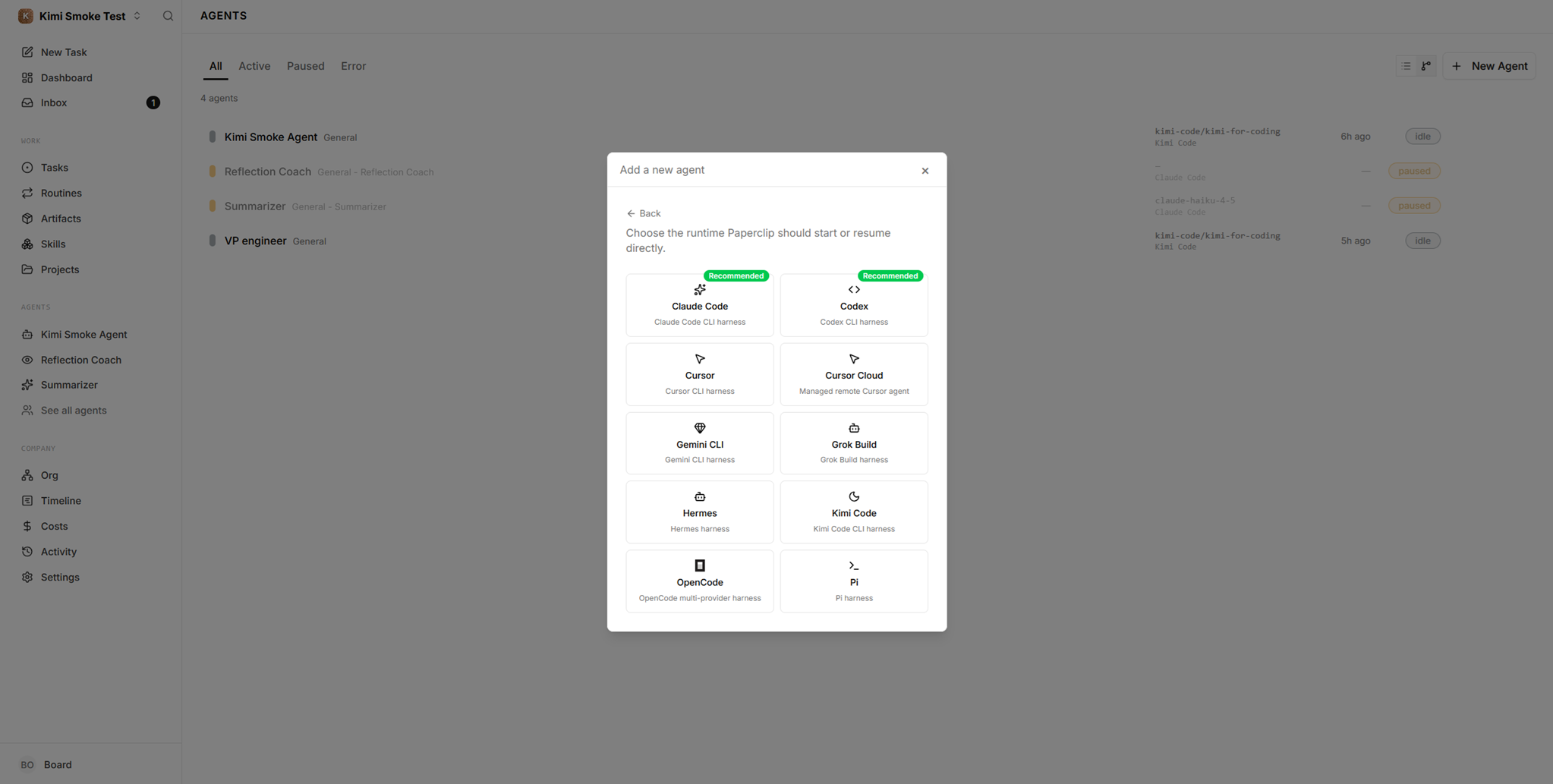 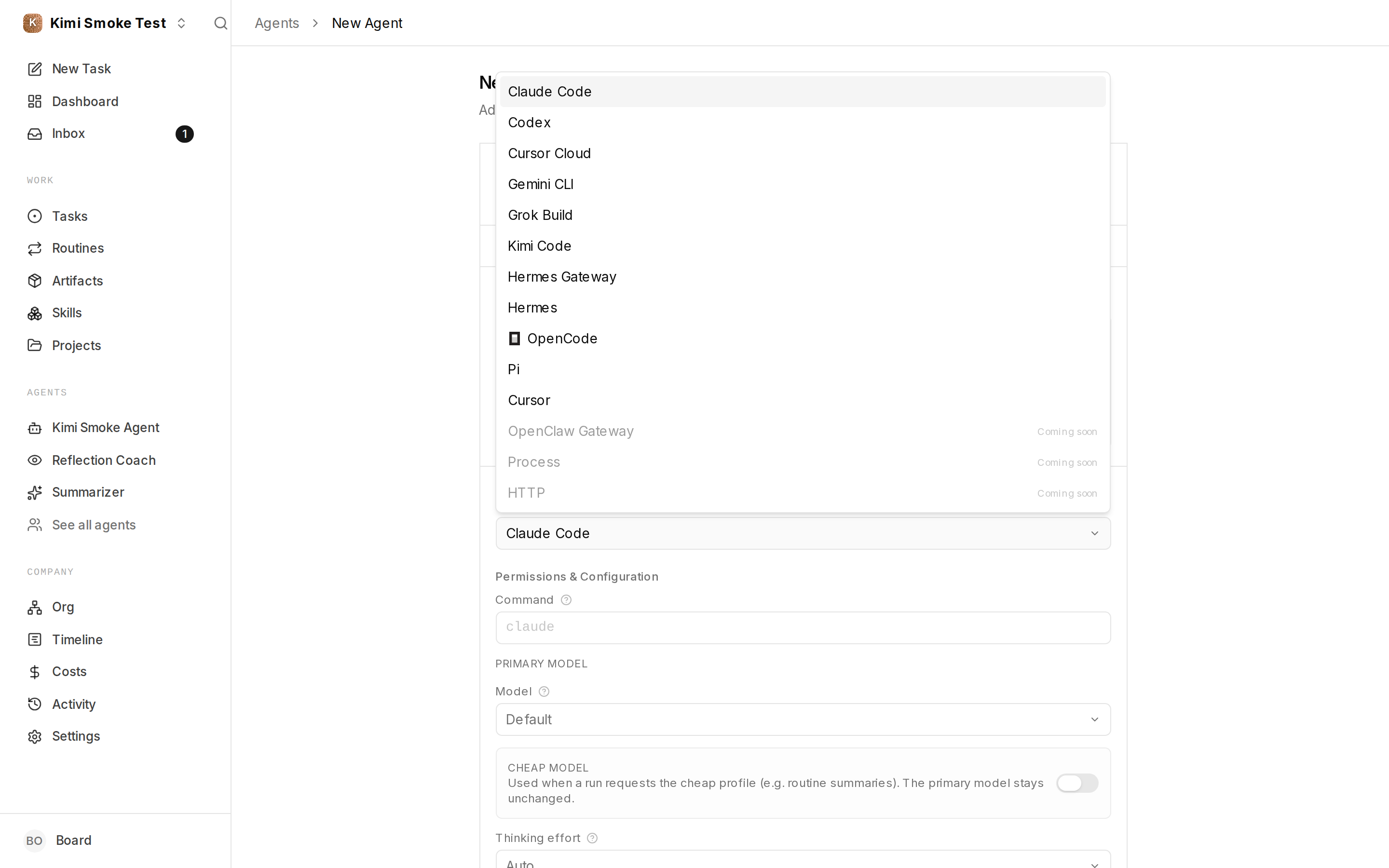 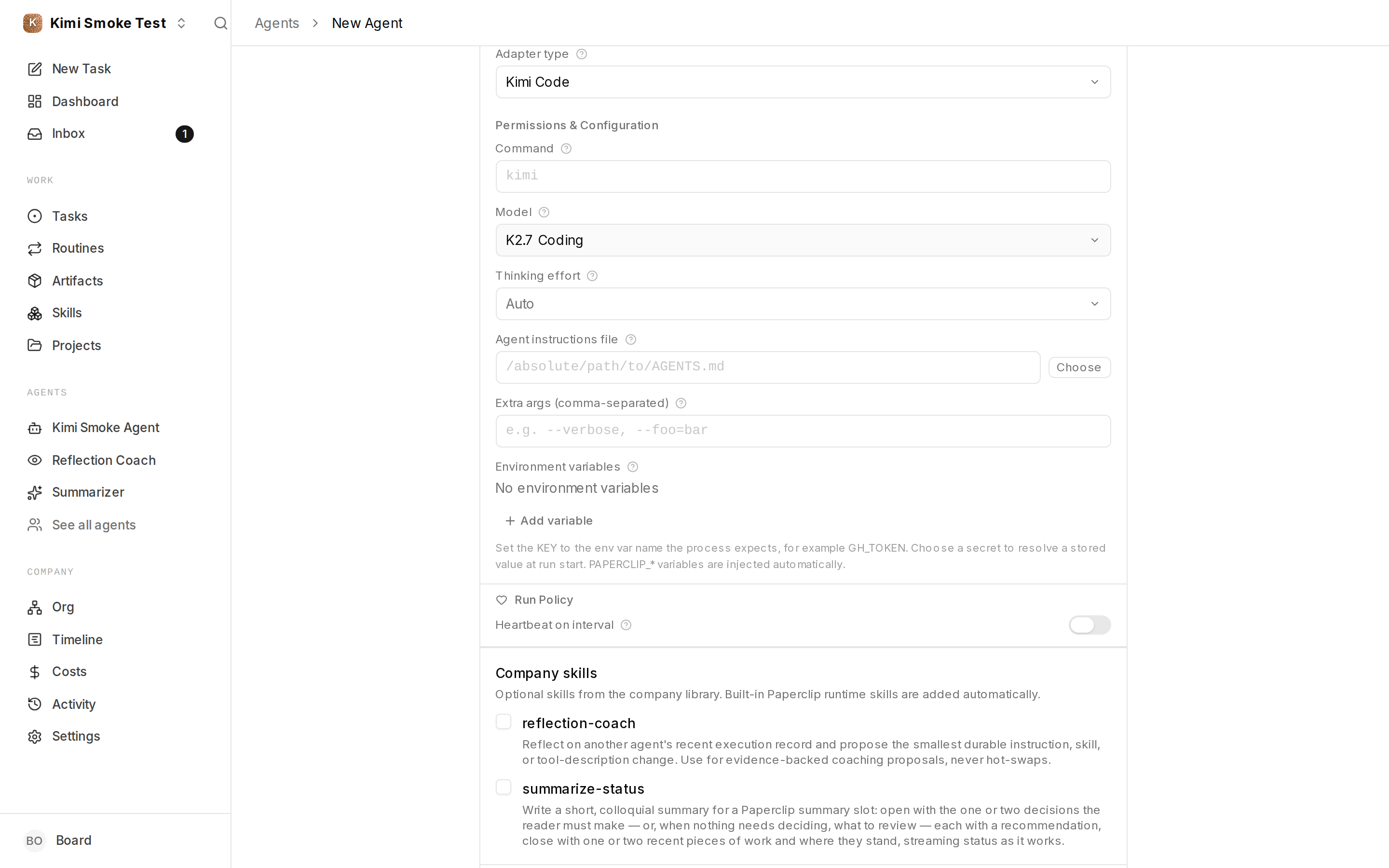 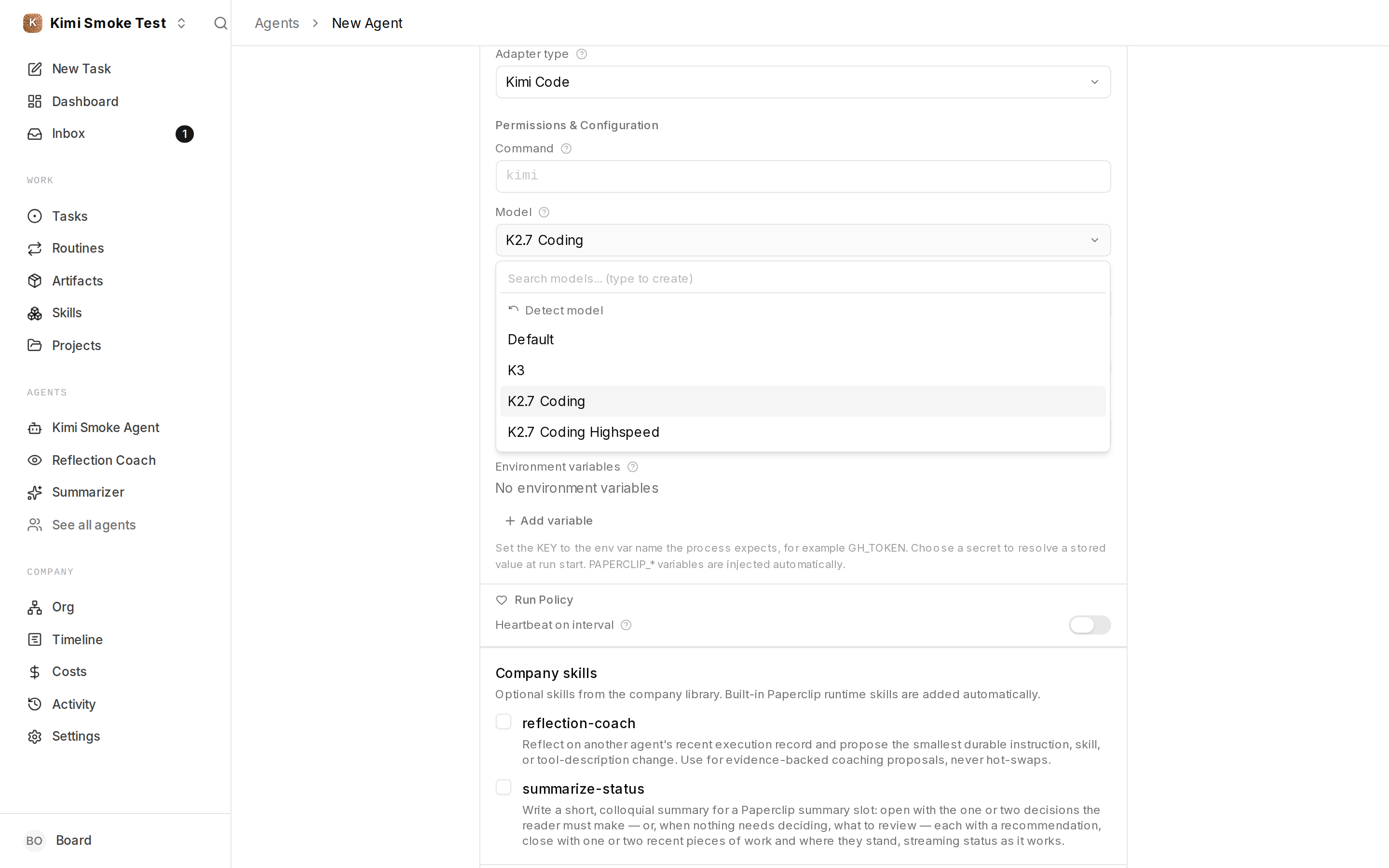 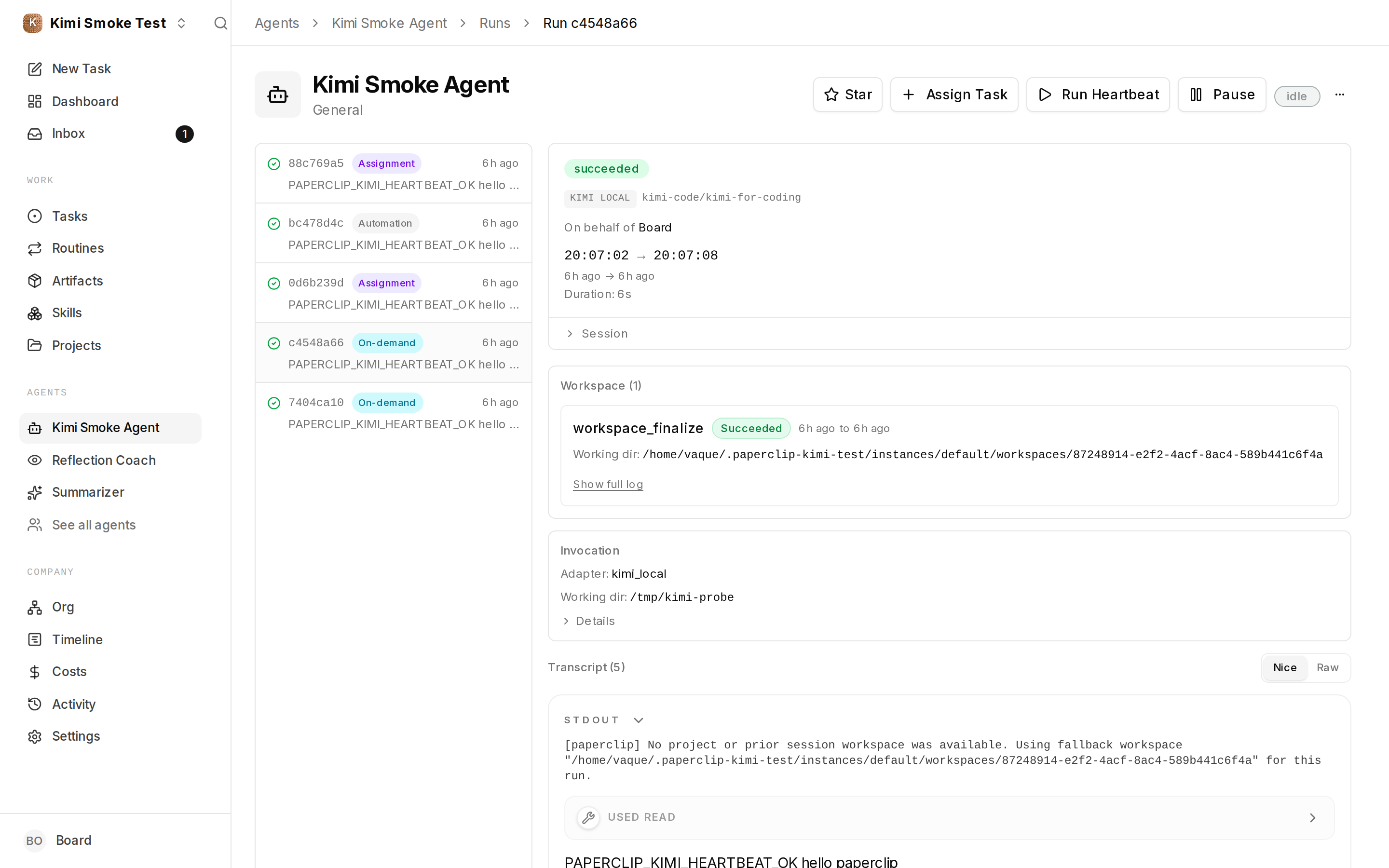 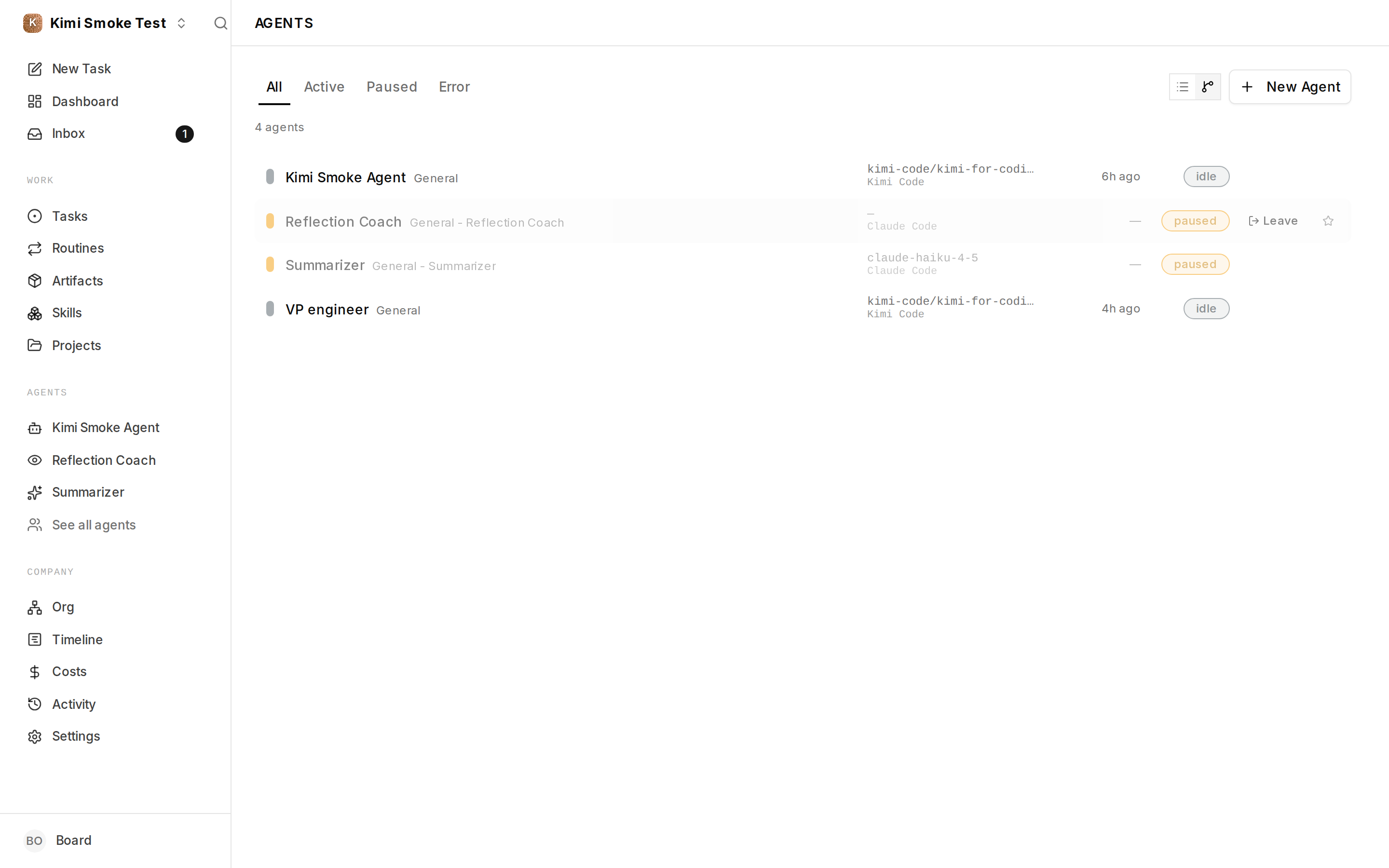 ## Risks - Low risk to existing behavior: the change is additive, one new workspace package plus single-entry registrations alongside existing adapters; no existing adapter code paths are modified. - The adapter invokes the locally installed `kimi` CLI; like other local adapters, run behavior depends on the host's Kimi version. The parser is written against the documented/verified 0.27.0 stream-json schema and degrades gracefully (malformed lines are skipped, failures surface as run errors). - `--skills-dir` overrides Kimi's auto-discovery of user and project skills for the run. This is intentional (paperclip-managed agents get a reproducible, isolated skill set), and it is only passed when at least one Paperclip skill is desired, so unconfigured agents keep default discovery. - Thinking effort is only forwarded to models that advertise `support_efforts` (currently `kimi-code/k3`); `EFFORT_CAPABLE_MODELS` must be extended when more Kimi models gain support, otherwise a configured effort is silently ignored for them. - `Dockerfile` now installs `@moonshot-ai/kimi-code@latest` globally alongside the other agent CLIs, so image size increases slightly. - Maintainer action needed for the npm bootstrap gate: the `policy` job's release-bootstrap step fails until the first npm publish of `@paperclipai/adapter-kimi-local` (the gate from #5146 that every new adapter package has passed through). Enrollment with `publishFromCi: true` is required by the manifest validator (dropping the entry, `false`, or `private` are all rejected), so this is intentionally left to a maintainer. Remaining CI lanes are expected to run once it is done. ## Model Used\n\n- **Current-master rebase, conflict adaptation, and registry-parity coverage:** OpenAI, **GPT-5 Codex** (Codex agent; exact serving model ID and context-window size were not exposed to the runtime), with repository, shell, Git, and GitHub tooling. It preserved Hawik’s commit authorship, reconciled ACPX and environment-capability changes, added current registry tests, and ran the verification above.\n- **Adapter implementation and initial review:** Moonshot AI, **Kimi K3 Coding** (latest), via **Kimi Code CLI v0.27.0** (`kimi-code/k3` alias, 1M-token context window, thinking mode, agentic tool use). The CLI agent explored the repo, wrote the adapter implementation (delegated to a coder sub-agent of the same model), ran tests, and drafted the first version of this PR body. A second model-driven review pass (read-only, same model) audited the diff for security/correctness before submission; its findings (shell-quoting hardening, auth-detection false positive, session-compaction registration, test gaps) were fixed and are included. - **Harness-context fixes and review responses:** Anthropic, **Claude Opus 4.8** (`claude-opus-4-8`) via Claude Code. Diagnosed from run logs that Kimi received only the entry instructions file (not the `HEARTBEAT.md`/`SOUL.md`/`TOOLS.md` bundle) and that `effort` was never wired, then implemented the instruction `--add-dir` delivery, `KIMI_MODEL_THINKING_EFFORT` forwarding, and `--skills-dir` skill delivery, added the accompanying tests and docs, and addressed the automated review comments (preserving external skills on remote sync, treating a signaled exit as a failure). Also extended the `paperclipai agent local-cli` installer to seed the control-plane skills into `~/.kimi-code/skills` for Codex/Claude parity, wired `onEvent` runtime events so the issue-thread activity indicator reflects Kimi's tool and reasoning output live, and built the ACP engine lane (`kimi acp` via the shared acpx engine, default) so the transcript streams with live tool status like the other ACP adapters. The Kimi CLI flags, subcommand, and env var relied on here were verified against the installed Kimi Code CLI 0.27.0. - All CLI behaviors claimed here (`-p`, `--output-format stream-json`, `-r` resume, event shapes, `--add-dir`, `--skills-dir`, `KIMI_MODEL_THINKING_EFFORT`) were verified empirically against the installed Kimi CLI, not assumed. ## Checklist - [x] I have included a thinking path that traces from project context to this change - [x] I have specified the model used (with version and capability details) - [x] I have checked ROADMAP.md and confirmed this PR does not duplicate planned core work - [x] I have searched GitHub for duplicate or related PRs and linked them above - [x] I have either (a) linked existing issues with `Fixes: #` / `Closes #` / `Refs #` OR (b) described the issue in-PR following the relevant issue template - [x] I have not referenced internal/instance-local Paperclip issues or links (only public GitHub `#NNN` / `github.com/paperclipai/paperclip` URLs) - [x] My branch name describes the change (e.g. `docs/...`, `fix/...`) and contains no internal Paperclip ticket id or instance-derived details - [x] I have run tests locally and they pass - [x] I have added or updated tests where applicable - [x] I have updated relevant documentation to reflect my changes - [x] I have considered and documented any risks above - [x] All Paperclip CI gates are green *(only the release-bootstrap step remains red, pending the maintainer npm publish described in Risks)* - [x] Greptile is 5/5 with no open P2s, recommendations, or follow-ups *(will address all Greptile comments as they arrive)* - [x] I will address all Greptile and reviewer comments before requesting merge --- ## Maintainer Addendum (2026-08-20) The shared acpx-engine and issue-chat changes (run-summary segmentation, placeholder tool-event coalescing, `ISSUE_CHAT_TRANSCRIPT_MAX_VISIBLE_ENTRIES` 30 → 400, live-reasoning UI) have been **extracted to #11761** so the cross-adapter behavior changes review and revert independently — both commits there preserve @hawikk's authorship. This PR is now the kimi-specific adapter only (60 files, +3,793/−8, essentially pure addition); the only shared-engine touch left is the `kimi acp` command resolution. `publishFromCi` is `true` — the package name is bootstrapped on npm. --------- Co-authored-by: Claude Opus 4.8 <noreply@anthropic.com> Co-authored-by: Paperclip <noreply@paperclip.ing> Co-authored-by: Dotta <bippadotta@protonmail.com> Co-authored-by: Devin Foley <devin@paperclip.ing> | 2 个月前 | |
fix(cli): materialize the managed install before the onboarding service install (#12148) ## Thinking Path > - Paperclip is the open source app people use to manage AI agents for work > - Interactive onboarding offers to install Paperclip as a background service, defaulting to yes > - The service definition targets the managed command shim, but an ephemeral npx run never installs it, and the service step never checks > - The result is a crash-looping service, a doctor hint about a nonexistent port conflict, and a first run that ends with nothing serving > - This pull request materializes the managed install before registering the service, or declines with the repair path > - The benefit is that saying yes to the service prompt yields a working service — or an honest explanation ## Linked Issues or Issue Description **What happened?** On a machine with no managed install, `npx paperclipai@2026.824.0 onboard` (interactive), accepting the background-service prompt, produced: a LaunchAgent pointing at `~/.local/bin/paperclipai` (which does not exist), launchd exit code 78 in a KeepAlive crash loop, doctor reporting "inactive but the configured port is serving another Paperclip process — stop the conflicting foreground process" (no such process existed), and "Service health: fetch failed". Reproduced twice on a clean field. `latest` has carried this path since v2026.817.0 shipped; CI never sees it because `--yes` onboarding skips the service prompt. **Expected behavior** Accepting the service prompt installs a working service (materializing the managed payload and shim first when needed), and doctor diagnoses a missing service binary as exactly that. **Steps to reproduce** On macOS with no `~/.local/bin/paperclipai`: `npx paperclipai@latest onboard`, accept the service prompt, then `launchctl print gui/$UID/ing.paperclip.paperclipai` (exit code 78, spawn scheduled) and `paperclipai doctor`. **Paperclip version or commit** `2026.824.0` (path present since #10045). ## What Changed - `cli/src/onboard-service.ts`: after the user opts in, an `ensureServiceShim` step checks the service shim path. Missing + managed-store location → run `installCommand` pinned to the onboarding version (payload, shim, PATH block), then proceed. Missing + custom `PAPERCLIP_SHIM_PATH`, or install failure → decline with `paperclipai install` / `paperclipai service install` guidance and install nothing. - `cli/src/checks/service-health-check.ts`: the runtime check diagnoses a missing service binary with the install repair hint (instead of the port-conflict hint); an inactive service with a healthy responder gets a `warn` attributing the foreign process instead of a plain "Healthy" pass. - Tests: new cases for shim materialization ordering, decline-on-failure, missing-binary diagnosis, and foreign-responder attribution; existing fixtures updated to inject the new dependencies. ## Verification - `vitest run` on both touched suites: 15 pass. - `tsc --noEmit` error count identical to the master baseline (16 pre-existing, all in `server/`, none in changed files). - The live failure was reproduced on macOS before the fix (twice, clean field) and the mechanism confirmed in source: `install()` writes the definition and bootstraps launchd only; `install-store` was previously reachable solely from the `install`/`update` commands. ## Risks - Low: the new path runs only when the user opts into the service and the shim is absent. The managed install resolves the pinned onboarding version from the public registry; on failure the flow declines exactly as it does on unsupported platforms. `--yes` quickstarts, Docker, and managed installs are untouched. ## Model Used Claude Fable 5 (Claude Code) ## Pre-submission checklist - [x] I have included a thinking path that traces from project context to this change - [x] I have specified the model used (with version and capability details) - [x] I have checked ROADMAP.md and confirmed this PR does not duplicate planned core work - [x] I have searched GitHub for duplicate or related PRs and linked them above - [x] I have either (a) linked existing issues with `Fixes: #` / `Closes #` / `Refs #` OR (b) described the issue in-PR following the relevant issue template | 1 个月前 | |
Harden Board CLI approval and native verification fixtures (#16482) Preserve governed Board CLI authority and strict verification fixtures on the Muse stack. Keep approval/cancel ownership, current membership/key authority and durable first-change audit atomic. Bound Retry-After scheduling within the original challenge; never automatically resubmit consent. Retain descriptor ownership until identity-based cleanup and close it on success and error. Keep strict Git-origin and synchronized provider-entry fixture assertions. Related public work: LukeAbell's existing PR #13919 proposes the same production descriptor-lifetime fix. This independently measured local integration retains the original tests and adds real-descriptor coverage. Do not treat this local integration as ownership of that contribution. Carry actual merged UI source 896f3c7f3bca5502ccb38c759ef356d799c0a60d through a normal forward merge, preserving canonical workspace recovery, Muse authority and existing migration bytes. Current-head CI and substantive review remain merge gates. Complete qualification of the final immutable canonical source and actual provider acceptance remain separate. Refs #16482, #13919. Co-Authored-By: Paperclip <noreply@paperclip.ing> | 5 天前 | |
Remove the Pipelines experiment and preserve its data (#16834) ## Thinking Path > - Paperclip manages AI agents and their work. > - Pipelines was an unused experiment with its own UI, API, CLI, and automation. > - Keeping it leaves unsupported product surfaces and extra task-detail queries. > - Removing the experiment must preserve data that users already saved. > - This pull request removes the feature and keeps its database schema and migration history. > - Cases and Routines remain available as separate features. ## Linked Issues or Issue Description **What existing behavior does this improve?** Remove the unused Pipelines experiment across the application. **Current behavior** The experiment includes pipeline boards, stage settings, case automation, review queues, learnings, permissions, and CLI commands. Task detail also queries pipeline links. **Proposed behavior** Remove all these product surfaces and their implementation. Preserve existing tables, records, and documents. Ignore the retired boolean in older managed configurations so upgrades still start. **Breaking changes** Pipeline URLs, API endpoints, CLI commands, and `pipelines:write` are removed. Task detail no longer includes the old `linkedCases` field. The independent Cases API remains available. No database migration or cleanup is included. Related feature work: #7907, #9110, #10905, #11375, #13004, #14671, #16133. Related issues: #9663, #10310, #10312. This removal supersedes the feature; it does not implement those pending enhancements or delete their saved data. ## What Changed - Remove Pipeline UI pages, navigation, gates, clients, query keys, helpers, and unused design tokens. - Remove Pipeline REST routes, services, automation dispatch, task-detail queries, and OpenAPI discovery. - Remove the CLI commands, shared contracts, experimental flag, catalog entry, and permission defaults. - Remove feature-specific tests, tutorials, smoke scripts, maps, and Storybook examples. - Preserve database schema, migration history, and the reserved document key used by old records. - Keep Cases routes independent and cover obsolete stored and managed settings. ## Verification - Passed: `pnpm build` and `pnpm -r typecheck`. - Passed: targeted settings, managed configuration, sidebar, settings UI, routing, and feature-catalog tests. A first sidebar run caught a shared Workspaces icon import; the import was restored and the sidebar rerun passed. - Passed: 40 tests covering Cases routes, OpenAPI discovery, retained Pipeline table constraints, and schema snapshot drift. - Passed: token gates, map validation, generated API metadata check, Storybook catalog validation, and 28 map/catalog tests. - Passed: isolated local browser verification of navigation and Experimental settings with Pipelines absent; Cases and Routines still open normally. Live GET/POST requests to retired Pipeline endpoints return 404, and the retired setting is absent. CLI help has no Pipeline commands. - Passed: 22 access-service and agent-default-grant tests after restoring unrelated permission assertions flagged in review. - Local full run: `pnpm test:run` reported one failure in the unchanged workspace-runtime port-allocation test. That test passed in an isolated rerun. The long local run was stopped after full CI passed; it is not reported as a complete local pass. - Passed: all 56 checks on `def9181f3a4491d95fca1d38e9739f5b821aae3e` (2 conditional checks skipped), including build, typecheck, test shards, and browser suites. Eleven interrupted CI jobs reported “The operation was canceled”; their one-time retry passed. [CI run](https://github.com/paperclipai/paperclip/actions/runs/39255211006). - Greptile: 5/5 on the final commit, with the only review finding fixed and resolved. - Sandbox socket restrictions affected the first build/API test attempts. The same commands ran with local sockets available. ## Risks - Existing Pipeline clients must stop using the removed endpoints and commands. - Existing data remains in the database and backups, but the removed UI no longer displays it. - Historical boolean `enablePipelines` values are ignored. They cannot restore the feature. - Cases and Routines must retain their separate behavior. Targeted route tests cover this boundary. ## Model Used OpenAI Codex, GPT-6, with repository inspection, editing, shell execution, and browser verification. The exact deployed model ID and context-window size are not exposed in this session. ## Checklist - [x] I have included a thinking path that traces from project context to this change - [x] I have specified the model used (with version and capability details) - [x] I have checked ROADMAP.md and confirmed this PR does not duplicate planned core work - [x] I have searched GitHub for duplicate or related PRs and linked them above - [x] I have either (a) linked existing issues with `Fixes: #` / `Closes #` / `Refs #` OR (b) described the issue in-PR following the relevant issue template - [x] I have not referenced internal/instance-local Paperclip issues or links (only public GitHub `#NNN` / `github.com/paperclipai/paperclip` URLs) - [x] My branch name describes the change (e.g. `docs/...`, `fix/...`) and contains no internal Paperclip ticket id or instance-derived details - [x] I have run tests locally and they pass - [x] I have added or updated tests where applicable - [x] I have updated relevant documentation to reflect my changes - [x] I have considered and documented any risks above - [x] All Paperclip CI gates are green - [x] Greptile is 5/5 with no open P2s, recommendations, or follow-ups - [x] I will address all Greptile and reviewer comments before requesting merge --------- Co-authored-by: Paperclip <noreply@paperclip.ing> | 4 天前 | |
feat(apps): consolidate connector management (#12684) Completes the post-managed-OAuth connector lifecycle, Paperclip Cloud provisioning defaults, governed test flows, and consolidated Apps UI.\n\nCo-Authored-By: Paperclip <noreply@paperclip.ing> | 1 个月前 | |
fix(cli): accept prompt defaults in onboarding wizard validators (#13520) ## Thinking Path > - Paperclip is the open source app people use to manage AI agents for work > - The CLI onboarding wizard's custom-setup path collects server, database, storage, and secrets configuration through `@clack/prompts` text prompts, most of which show a sensible default > - `@clack/prompts` runs each prompt's `validate` callback on the raw typed value, and only substitutes `defaultValue` after validation passes — so pressing Enter to accept a shown default hands the validator an empty string > - Eleven of the wizard's validators reject the empty string, which makes their own displayed defaults unacceptable: accepting "Embedded PostgreSQL port: 54329" fails with "Port must be an integer between 1 and 65535", "Backup directory" fails with "Backup directory is required", and so on through every prompt in the custom path > - This pull request makes each affected validator accept empty input when a default exists, while keeping all real validation for typed input > - The benefit is that the custom-setup wizard is walkable by pressing Enter through the defaults, as the UI clearly intends ## Linked Issues or Issue Description No existing issue. Description follows the bug-report template: **What happened?** In `paperclipai onboard` custom setup, pressing Enter to accept a prompt's displayed default fails validation on eleven prompts. Confirmed live on the "Embedded PostgreSQL port" prompt (default 54329 → "Port must be an integer between 1 and 65535") and the "Backup directory" prompt (populated default path → "Backup directory is required"). The only way through is to retype every default by hand. **Expected behavior** Pressing Enter accepts the displayed default, as in every standard `@clack/prompts` flow. **Steps to reproduce** 1. `npx paperclipai onboard` → choose Custom setup. 2. At "Embedded PostgreSQL port", press Enter to accept the shown default. 3. Validation rejects it. Same for the backup directory, backup interval/retention, server port, bind host, storage directory, S3 bucket/region, and secrets key-file prompts. **Paperclip version or commit** Reproduced on `2026.915.0-canary.11`; the same validators exist in the latest stable (`v2026.831.1`) — long-standing, not a recent regression. **Deployment mode** Any (the bug is in the CLI wizard). **Installation method** `npx paperclipai onboard`. ## What Changed - Audited all 15 `validate:` callbacks across `cli/src/prompts/{database,server,storage,llm,secrets}.ts`. Eleven rejected the empty string while displaying a default; two were already fine (hostname CSV prompts, where empty parses to `[]`); one is an intentionally required password with no default (left alone); one (PostgreSQL connection string) and one (public base URL) are conditionally required — empty now passes only when a saved default exists, so fresh setups still enforce the field - Fix pattern: allow empty/undefined input at the top of each affected validator; every check for non-empty typed input is unchanged. One deliberate exception: the bind-host validator validates `(val || defaultHost)` so accepting the default still runs the loopback safety check rather than bypassing it - New `cli/src/__tests__/prompt-default-accept.test.ts` (repo-convention vitest + clack mock reproducing real submit semantics — validate raw `""`, then substitute the default): drives the four prompt modules end-to-end and unit-exercises each captured validator (empty accepted, garbage still rejected, required-when-fresh still rejected) ## Verification - `pnpm exec vitest run src/__tests__/prompt-default-accept.test.ts` in `cli/`: 13/13 pass; with the prompt fixes stashed: 12/13 fail — the suite reproduces the bug - Full cli suite: 483 passed; 15 failures are pre-existing/environmental on the clean tree too (macOS `/var` realpath mismatch in `worktree.test.ts`, one parallel-run flake that passes in isolation) - `pnpm run typecheck` in `cli/`: zero errors in `cli/src` (the 228 pre-existing errors in `../server/src` from missing prebuilt workspace dist are identical with and without the change) ## Risks - Low. Typed input validates exactly as before; whitespace-only input is still rejected (clack substitutes the default only for truly-empty input). The two conditionally-required prompts still hard-require a value on fresh setups - No migrations, no API surface changes; CLI-only ## Model Used Claude Fable 5 (`claude-fable-5`), extended thinking with tool use (Claude Code); implementation drafted by a subagent on the same model and reviewed before commit. ## Checklist - [x] I have included a thinking path that traces from project context to this change - [x] I have specified the model used (with version and capability details) - [x] I have checked ROADMAP.md and confirmed this PR does not duplicate planned core work - [x] I have searched GitHub for duplicate or related PRs and linked them above - [x] I have either (a) linked existing issues with `Fixes: #` / `Closes #` / `Refs #` OR (b) described the issue in-PR following the relevant issue template - [x] I have not referenced internal/instance-local Paperclip issues or links (only public GitHub `#NNN` / `github.com/paperclipai/paperclip` URLs) - [x] My branch name describes the change (e.g. `docs/...`, `fix/...`) and contains no internal Paperclip ticket id or instance-derived details - [x] I have run tests locally and they pass - [x] I have added or updated tests where applicable - [x] I have updated relevant documentation to reflect my changes - [x] I have considered and documented any risks above - [x] All Paperclip CI gates are green - [x] Greptile is 5/5 with no open P2s, recommendations, or follow-ups - [x] I will address all Greptile and reviewer comments before requesting merge | 1 个月前 | |
fix(cli): materialize the managed install before the onboarding service install (#12148) ## Thinking Path > - Paperclip is the open source app people use to manage AI agents for work > - Interactive onboarding offers to install Paperclip as a background service, defaulting to yes > - The service definition targets the managed command shim, but an ephemeral npx run never installs it, and the service step never checks > - The result is a crash-looping service, a doctor hint about a nonexistent port conflict, and a first run that ends with nothing serving > - This pull request materializes the managed install before registering the service, or declines with the repair path > - The benefit is that saying yes to the service prompt yields a working service — or an honest explanation ## Linked Issues or Issue Description **What happened?** On a machine with no managed install, `npx paperclipai@2026.824.0 onboard` (interactive), accepting the background-service prompt, produced: a LaunchAgent pointing at `~/.local/bin/paperclipai` (which does not exist), launchd exit code 78 in a KeepAlive crash loop, doctor reporting "inactive but the configured port is serving another Paperclip process — stop the conflicting foreground process" (no such process existed), and "Service health: fetch failed". Reproduced twice on a clean field. `latest` has carried this path since v2026.817.0 shipped; CI never sees it because `--yes` onboarding skips the service prompt. **Expected behavior** Accepting the service prompt installs a working service (materializing the managed payload and shim first when needed), and doctor diagnoses a missing service binary as exactly that. **Steps to reproduce** On macOS with no `~/.local/bin/paperclipai`: `npx paperclipai@latest onboard`, accept the service prompt, then `launchctl print gui/$UID/ing.paperclip.paperclipai` (exit code 78, spawn scheduled) and `paperclipai doctor`. **Paperclip version or commit** `2026.824.0` (path present since #10045). ## What Changed - `cli/src/onboard-service.ts`: after the user opts in, an `ensureServiceShim` step checks the service shim path. Missing + managed-store location → run `installCommand` pinned to the onboarding version (payload, shim, PATH block), then proceed. Missing + custom `PAPERCLIP_SHIM_PATH`, or install failure → decline with `paperclipai install` / `paperclipai service install` guidance and install nothing. - `cli/src/checks/service-health-check.ts`: the runtime check diagnoses a missing service binary with the install repair hint (instead of the port-conflict hint); an inactive service with a healthy responder gets a `warn` attributing the foreign process instead of a plain "Healthy" pass. - Tests: new cases for shim materialization ordering, decline-on-failure, missing-binary diagnosis, and foreign-responder attribution; existing fixtures updated to inject the new dependencies. ## Verification - `vitest run` on both touched suites: 15 pass. - `tsc --noEmit` error count identical to the master baseline (16 pre-existing, all in `server/`, none in changed files). - The live failure was reproduced on macOS before the fix (twice, clean field) and the mechanism confirmed in source: `install()` writes the definition and bootstraps launchd only; `install-store` was previously reachable solely from the `install`/`update` commands. ## Risks - Low: the new path runs only when the user opts into the service and the shim is absent. The managed install resolves the pinned onboarding version from the public registry; on failure the flow declines exactly as it does on unsupported platforms. `--yes` quickstarts, Docker, and managed installs are untouched. ## Model Used Claude Fable 5 (Claude Code) ## Pre-submission checklist - [x] I have included a thinking path that traces from project context to this change - [x] I have specified the model used (with version and capability details) - [x] I have checked ROADMAP.md and confirmed this PR does not duplicate planned core work - [x] I have searched GitHub for duplicate or related PRs and linked them above - [x] I have either (a) linked existing issues with `Fixes: #` / `Closes #` / `Refs #` OR (b) described the issue in-PR following the relevant issue template | 1 个月前 | |
fix(cli): open dashboard after onboarding service starts (#12164) ## Thinking Path > - Paperclip is the open source app people use to manage AI agents for work. > - The CLI can install and start Paperclip as a managed user service during onboarding. > - Recent fixes now install the service shim and remove the redundant foreground start prompt. > - The service path still ends without a dashboard URL or an open browser. > - The server can also move to a free port when the configured port is busy. > - This pull request adds a health-aware handoff to the managed service's actual endpoint. > - The benefit is that new users can reach Paperclip without starting a second process. ## Linked Issues or Issue Description **What happened?** After interactive onboarding installs and starts the managed service, the command ends without printing the dashboard URL or opening the browser. If the configured port is busy, the service can use a fallback port that the onboarding process does not know. **Expected behavior** Onboarding must print the dashboard URL that belongs to the managed service. An interactive terminal should open the URL after the local health check succeeds. A non-interactive terminal should only print the URL. **Steps to reproduce** 1. Start from a host without an installed Paperclip service. 2. Run another process on the configured Paperclip port. 3. Run `npx paperclipai@<version> onboard` in an interactive terminal. 4. Accept the managed service installation. 5. Observe that the service starts on a fallback port, but onboarding does not provide or open that dashboard URL. **Paperclip version or commit** `b6854e61c` on `master`, after #12148, #12151, and #12153. **Deployment mode** Local managed user service on macOS or Linux. **Installation method** `npx paperclipai@<version> onboard`. The same onboarding path can also run after `install.sh`. Related public pull requests: #12148, #12151, and #12153. ## What Changed - Record each running CLI server's PID, selected port, and dashboard URL in atomic per-instance runtime metadata. - Accept runtime metadata only when its PID matches the active managed service. - Wait for the selected runtime endpoint to report healthy before printing its URL. - Open the URL in interactive terminals and keep headless runs browser-free. - Keep the printed configured URL as a fallback when runtime discovery fails. - Use browser-launch wording that only claims the URL was sent to the opener. - Add runtime metadata, fallback-port, health handoff, headless, and failure-path tests. - Document the managed service dashboard handoff. ## Verification - `pnpm exec vitest run cli/src/__tests__/onboard-service.test.ts cli/src/__tests__/runtime-info.test.ts cli/src/__tests__/onboard.test.ts cli/src/__tests__/open-url.test.ts cli/src/__tests__/service-health-check.test.ts` — 44 tests passed. - `node --test scripts/service-onboard-smoke.test.mjs` — 4 tests passed. - `pnpm -r typecheck` — passed on head `82920596a`. - `pnpm build` — passed on head `82920596a`. - `pnpm test:run` — 4,685 tests passed. The command also reported 31 failures in nine server test files outside this change. This machine generated invalid test ports above 65,535, and some project-skill fixtures resolved outside the worktree. ## Risks - Risk is low because the new handoff runs only after a successful service installation. - Onboarding can wait up to 60 seconds when runtime metadata or the health check does not become ready. - Runtime metadata is matched to the supervisor PID, so stale or foreground-process metadata is ignored. - A non-interactive terminal does not open a browser. - A failed health check or browser launch does not fail onboarding. The CLI keeps a manual URL visible. > For core feature work, check [`ROADMAP.md`](ROADMAP.md) first and discuss it in `#dev` before opening the PR. Feature PRs that overlap with planned core work may need to be redirected — check the roadmap first. See `CONTRIBUTING.md`. ## Model Used OpenAI Codex, GPT-5 family. The runtime did not expose the exact model ID or context window. The model used reasoning, repository tools, GitHub access, and code execution. ## Checklist - [x] I have included a thinking path that traces from project context to this change - [x] I have specified the model used (with version and capability details) - [x] I have checked ROADMAP.md and confirmed this PR does not duplicate planned core work - [x] I have searched GitHub for duplicate or related PRs and linked them above - [x] I have either (a) linked existing issues with `Fixes: #` / `Closes #` / `Refs #` OR (b) described the issue in-PR following the relevant issue template - [x] I have not referenced internal/instance-local Paperclip issues or links (only public GitHub `#NNN` / `github.com/paperclipai/paperclip` URLs) - [x] My branch name describes the change (e.g. `docs/...`, `fix/...`) and contains no internal Paperclip ticket id or instance-derived details - [x] I have run tests locally and they pass - [x] I have added or updated tests where applicable - [x] I have updated relevant documentation to reflect my changes - [x] I have considered and documented any risks above - [x] All Paperclip CI gates are green - [x] Greptile is 5/5 with no open P2s, recommendations, or follow-ups - [x] I will address all Greptile and reviewer comments before requesting merge --------- Co-authored-by: Paperclip <noreply@paperclip.ing> | 1 个月前 | |
Remove the Pipelines experiment and preserve its data (#16834) ## Thinking Path > - Paperclip manages AI agents and their work. > - Pipelines was an unused experiment with its own UI, API, CLI, and automation. > - Keeping it leaves unsupported product surfaces and extra task-detail queries. > - Removing the experiment must preserve data that users already saved. > - This pull request removes the feature and keeps its database schema and migration history. > - Cases and Routines remain available as separate features. ## Linked Issues or Issue Description **What existing behavior does this improve?** Remove the unused Pipelines experiment across the application. **Current behavior** The experiment includes pipeline boards, stage settings, case automation, review queues, learnings, permissions, and CLI commands. Task detail also queries pipeline links. **Proposed behavior** Remove all these product surfaces and their implementation. Preserve existing tables, records, and documents. Ignore the retired boolean in older managed configurations so upgrades still start. **Breaking changes** Pipeline URLs, API endpoints, CLI commands, and `pipelines:write` are removed. Task detail no longer includes the old `linkedCases` field. The independent Cases API remains available. No database migration or cleanup is included. Related feature work: #7907, #9110, #10905, #11375, #13004, #14671, #16133. Related issues: #9663, #10310, #10312. This removal supersedes the feature; it does not implement those pending enhancements or delete their saved data. ## What Changed - Remove Pipeline UI pages, navigation, gates, clients, query keys, helpers, and unused design tokens. - Remove Pipeline REST routes, services, automation dispatch, task-detail queries, and OpenAPI discovery. - Remove the CLI commands, shared contracts, experimental flag, catalog entry, and permission defaults. - Remove feature-specific tests, tutorials, smoke scripts, maps, and Storybook examples. - Preserve database schema, migration history, and the reserved document key used by old records. - Keep Cases routes independent and cover obsolete stored and managed settings. ## Verification - Passed: `pnpm build` and `pnpm -r typecheck`. - Passed: targeted settings, managed configuration, sidebar, settings UI, routing, and feature-catalog tests. A first sidebar run caught a shared Workspaces icon import; the import was restored and the sidebar rerun passed. - Passed: 40 tests covering Cases routes, OpenAPI discovery, retained Pipeline table constraints, and schema snapshot drift. - Passed: token gates, map validation, generated API metadata check, Storybook catalog validation, and 28 map/catalog tests. - Passed: isolated local browser verification of navigation and Experimental settings with Pipelines absent; Cases and Routines still open normally. Live GET/POST requests to retired Pipeline endpoints return 404, and the retired setting is absent. CLI help has no Pipeline commands. - Passed: 22 access-service and agent-default-grant tests after restoring unrelated permission assertions flagged in review. - Local full run: `pnpm test:run` reported one failure in the unchanged workspace-runtime port-allocation test. That test passed in an isolated rerun. The long local run was stopped after full CI passed; it is not reported as a complete local pass. - Passed: all 56 checks on `def9181f3a4491d95fca1d38e9739f5b821aae3e` (2 conditional checks skipped), including build, typecheck, test shards, and browser suites. Eleven interrupted CI jobs reported “The operation was canceled”; their one-time retry passed. [CI run](https://github.com/paperclipai/paperclip/actions/runs/39255211006). - Greptile: 5/5 on the final commit, with the only review finding fixed and resolved. - Sandbox socket restrictions affected the first build/API test attempts. The same commands ran with local sockets available. ## Risks - Existing Pipeline clients must stop using the removed endpoints and commands. - Existing data remains in the database and backups, but the removed UI no longer displays it. - Historical boolean `enablePipelines` values are ignored. They cannot restore the feature. - Cases and Routines must retain their separate behavior. Targeted route tests cover this boundary. ## Model Used OpenAI Codex, GPT-6, with repository inspection, editing, shell execution, and browser verification. The exact deployed model ID and context-window size are not exposed in this session. ## Checklist - [x] I have included a thinking path that traces from project context to this change - [x] I have specified the model used (with version and capability details) - [x] I have checked ROADMAP.md and confirmed this PR does not duplicate planned core work - [x] I have searched GitHub for duplicate or related PRs and linked them above - [x] I have either (a) linked existing issues with `Fixes: #` / `Closes #` / `Refs #` OR (b) described the issue in-PR following the relevant issue template - [x] I have not referenced internal/instance-local Paperclip issues or links (only public GitHub `#NNN` / `github.com/paperclipai/paperclip` URLs) - [x] My branch name describes the change (e.g. `docs/...`, `fix/...`) and contains no internal Paperclip ticket id or instance-derived details - [x] I have run tests locally and they pass - [x] I have added or updated tests where applicable - [x] I have updated relevant documentation to reflect my changes - [x] I have considered and documented any risks above - [x] All Paperclip CI gates are green - [x] Greptile is 5/5 with no open P2s, recommendations, or follow-ups - [x] I will address all Greptile and reviewer comments before requesting merge --------- Co-authored-by: Paperclip <noreply@paperclip.ing> | 4 天前 | |
fix(adapters): prevent engine fallback and preserve usable runtime defaults (#13105) ## Thinking Path > - Paperclip manages agents that must write work and report task outcomes through its API. > - Local adapters select an execution engine and its permission settings. > - A higher ACP Node requirement can make an unchanged installation lose access to its default engine. > - The adapter then silently selects CLI, which can change permissions and block API access. > - This pull request keeps the engine choice fixed and reports missing prerequisites before work starts. > - It also gives explicit Codex CLI runs usable defaults and keeps managed services on a supported Node runtime. ## Linked Issues or Issue Description Refs #12215. Related changes: #11792 raised the Node requirement; #13094 addressed separate runner networking behavior. This change fixes the engine-selection and managed-launcher paths. **What happened?** An unchanged agent could switch from ACP to CLI after an upgrade. Codex CLI then used read-only permissions with networking disabled. The run could finish without updating its task. Repeated recovery attempts used the same unavailable setup. Managed updates also skipped the Node check and did not refresh old launchers. **Expected behavior** An unavailable engine must fail with a clear setup error. It must not silently select another engine. Explicit CLI runs must be able to write workspace files and call the API unless the operator configures stricter settings. Managed updates must validate Node and keep child tools on that runtime. **Steps to reproduce** 1. Run an ACP-default agent under Node 22 after the ACP minimum rises to 24.11. 2. Leave the engine unset and disable the approval/sandbox bypass. 3. Observe the old adapter select CLI and fail to write task disposition through the API. 4. Start a managed service with an old launcher and a supervisor PATH that selects a different Node for child tools. ## What Changed - Remove automatic engine fallback for Codex, Claude, Gemini, and Kimi. Check prerequisites for default and explicit ACP selections. - Return a configuration error with proof that provider work did not start. Stop automatic continuation retries for this error. - Enable Codex ACP workspace networking at the actual turn boundary. Upstream mode presets otherwise force it off even when config.toml enables it. Preserve explicit network denial and read-only mode. - Set workspace-write and network access defaults for explicit Codex CLI runs. Preserve explicit sandbox modes, profiles, and network restrictions. - Pin the validated Node directory in managed launcher PATH. Refresh legacy launchers during installs and npm/Git updates. - Reject updates on unsupported Node. Keep update checks, dry runs, and rollback available. - Synchronize the qualified Codex ACP executable identity across server, TypeScript runner, Rust runner, and provider-pack launch paths. - Add regression tests and update engine and installation documentation. ## Verification - [Full CI passed on the final head](https://github.com/paperclipai/paperclip/actions/runs/34387099695): typecheck, build/native runner verification, all general and serialized test shards, all browser shards, release registry, canary dry run, and policy checks. - Greptile: 5/5 on `2c1d6e2815830a5cd39e36c8a082cc0c4441b6c0`, with no unresolved review findings. Security gates are green. - Full workspace typecheck and build also passed locally. The final deployed Linux build passed. - Full Codex, Claude, Gemini, and Kimi source test suites: 804 passed, 2 skipped. Installer, updater, and launcher tests: 47 passed. Installed ACP turn-boundary tests: 3 passed. ACP packaging tests: 14 passed. Focused recovery classification tests also passed. - Real Linux Codex CLI runs, both fresh and resumed, wrote a workspace file and reached the control-plane health API with the new defaults. - Explicit read-only and network-disabled control probes retained those restrictions. - A real ACP run on the final deployed Linux build wrote a file and reached the control-plane API with HTTP 200, without engine fallback. The same probe failed DNS before the turn-policy patch. - Executable-identity and installed-policy contracts: 12 passed. Affected native server tests: 197 passed. Runner factory tests: 21 passed. Rust qualification and native provider integration tests: 11 passed. - Deployed the production changes to a Linux service on Node 24.20 after a verified database backup. Health, bootstrap readiness, static UI, executable/cwd identity, and guarded restart checks passed. The restart lost no runs. - Corrected stale Kimi skill-default and Gemini remote-archive fixtures; both suites pass. ## Risks - Default or legacy auto engine settings now fail when ACP is unavailable. Operators who intend to use CLI must select it explicitly. - Codex CLI now permits workspace writes and networking by default, and ACP workspace-write turns permit networking by default. Explicit operator sandbox settings remain authoritative. - Old managed launchers keep their pinned Node until they are reinstalled under a supported runtime. An old updater cannot repair itself; the documentation gives the current installer command. - Custom service wrappers and global/source installations must configure their runtime PATH. No database migration is required. ## Model Used OpenAI Codex, based on GPT-6, with reasoning, repository inspection, shell execution, and test tools. The exact serving model identifier and context-window size are not exposed in this session. ## Checklist - [x] I have included a thinking path that traces from project context to this change - [x] I have specified the model used (with version and capability details) - [x] I have checked ROADMAP.md and confirmed this PR does not duplicate planned core work - [x] I have searched GitHub for duplicate or related PRs and linked them above - [x] I have either (a) linked existing issues with `Fixes: #` / `Closes #` / `Refs #` OR (b) described the issue in-PR following the relevant issue template - [x] I have not referenced internal/instance-local Paperclip issues or links (only public GitHub `#NNN` / `github.com/paperclipai/paperclip` URLs) - [x] My branch name describes the change (e.g. `docs/...`, `fix/...`) and contains no internal Paperclip ticket id or instance-derived details - [x] I have run tests locally and they pass - [x] I have added or updated tests where applicable - [x] I have updated relevant documentation to reflect my changes - [x] I have considered and documented any risks above - [x] All Paperclip CI gates are green - [x] Greptile is 5/5 with no open P2s, recommendations, or follow-ups - [x] I will address all Greptile and reviewer comments before requesting merge --------- Co-authored-by: Paperclip <noreply@paperclip.ing> | 1 个月前 | |
fix(adapters): prevent engine fallback and preserve usable runtime defaults (#13105) ## Thinking Path > - Paperclip manages agents that must write work and report task outcomes through its API. > - Local adapters select an execution engine and its permission settings. > - A higher ACP Node requirement can make an unchanged installation lose access to its default engine. > - The adapter then silently selects CLI, which can change permissions and block API access. > - This pull request keeps the engine choice fixed and reports missing prerequisites before work starts. > - It also gives explicit Codex CLI runs usable defaults and keeps managed services on a supported Node runtime. ## Linked Issues or Issue Description Refs #12215. Related changes: #11792 raised the Node requirement; #13094 addressed separate runner networking behavior. This change fixes the engine-selection and managed-launcher paths. **What happened?** An unchanged agent could switch from ACP to CLI after an upgrade. Codex CLI then used read-only permissions with networking disabled. The run could finish without updating its task. Repeated recovery attempts used the same unavailable setup. Managed updates also skipped the Node check and did not refresh old launchers. **Expected behavior** An unavailable engine must fail with a clear setup error. It must not silently select another engine. Explicit CLI runs must be able to write workspace files and call the API unless the operator configures stricter settings. Managed updates must validate Node and keep child tools on that runtime. **Steps to reproduce** 1. Run an ACP-default agent under Node 22 after the ACP minimum rises to 24.11. 2. Leave the engine unset and disable the approval/sandbox bypass. 3. Observe the old adapter select CLI and fail to write task disposition through the API. 4. Start a managed service with an old launcher and a supervisor PATH that selects a different Node for child tools. ## What Changed - Remove automatic engine fallback for Codex, Claude, Gemini, and Kimi. Check prerequisites for default and explicit ACP selections. - Return a configuration error with proof that provider work did not start. Stop automatic continuation retries for this error. - Enable Codex ACP workspace networking at the actual turn boundary. Upstream mode presets otherwise force it off even when config.toml enables it. Preserve explicit network denial and read-only mode. - Set workspace-write and network access defaults for explicit Codex CLI runs. Preserve explicit sandbox modes, profiles, and network restrictions. - Pin the validated Node directory in managed launcher PATH. Refresh legacy launchers during installs and npm/Git updates. - Reject updates on unsupported Node. Keep update checks, dry runs, and rollback available. - Synchronize the qualified Codex ACP executable identity across server, TypeScript runner, Rust runner, and provider-pack launch paths. - Add regression tests and update engine and installation documentation. ## Verification - [Full CI passed on the final head](https://github.com/paperclipai/paperclip/actions/runs/34387099695): typecheck, build/native runner verification, all general and serialized test shards, all browser shards, release registry, canary dry run, and policy checks. - Greptile: 5/5 on `2c1d6e2815830a5cd39e36c8a082cc0c4441b6c0`, with no unresolved review findings. Security gates are green. - Full workspace typecheck and build also passed locally. The final deployed Linux build passed. - Full Codex, Claude, Gemini, and Kimi source test suites: 804 passed, 2 skipped. Installer, updater, and launcher tests: 47 passed. Installed ACP turn-boundary tests: 3 passed. ACP packaging tests: 14 passed. Focused recovery classification tests also passed. - Real Linux Codex CLI runs, both fresh and resumed, wrote a workspace file and reached the control-plane health API with the new defaults. - Explicit read-only and network-disabled control probes retained those restrictions. - A real ACP run on the final deployed Linux build wrote a file and reached the control-plane API with HTTP 200, without engine fallback. The same probe failed DNS before the turn-policy patch. - Executable-identity and installed-policy contracts: 12 passed. Affected native server tests: 197 passed. Runner factory tests: 21 passed. Rust qualification and native provider integration tests: 11 passed. - Deployed the production changes to a Linux service on Node 24.20 after a verified database backup. Health, bootstrap readiness, static UI, executable/cwd identity, and guarded restart checks passed. The restart lost no runs. - Corrected stale Kimi skill-default and Gemini remote-archive fixtures; both suites pass. ## Risks - Default or legacy auto engine settings now fail when ACP is unavailable. Operators who intend to use CLI must select it explicitly. - Codex CLI now permits workspace writes and networking by default, and ACP workspace-write turns permit networking by default. Explicit operator sandbox settings remain authoritative. - Old managed launchers keep their pinned Node until they are reinstalled under a supported runtime. An old updater cannot repair itself; the documentation gives the current installer command. - Custom service wrappers and global/source installations must configure their runtime PATH. No database migration is required. ## Model Used OpenAI Codex, based on GPT-6, with reasoning, repository inspection, shell execution, and test tools. The exact serving model identifier and context-window size are not exposed in this session. ## Checklist - [x] I have included a thinking path that traces from project context to this change - [x] I have specified the model used (with version and capability details) - [x] I have checked ROADMAP.md and confirmed this PR does not duplicate planned core work - [x] I have searched GitHub for duplicate or related PRs and linked them above - [x] I have either (a) linked existing issues with `Fixes: #` / `Closes #` / `Refs #` OR (b) described the issue in-PR following the relevant issue template - [x] I have not referenced internal/instance-local Paperclip issues or links (only public GitHub `#NNN` / `github.com/paperclipai/paperclip` URLs) - [x] My branch name describes the change (e.g. `docs/...`, `fix/...`) and contains no internal Paperclip ticket id or instance-derived details - [x] I have run tests locally and they pass - [x] I have added or updated tests where applicable - [x] I have updated relevant documentation to reflect my changes - [x] I have considered and documented any risks above - [x] All Paperclip CI gates are green - [x] Greptile is 5/5 with no open P2s, recommendations, or follow-ups - [x] I will address all Greptile and reviewer comments before requesting merge --------- Co-authored-by: Paperclip <noreply@paperclip.ing> | 1 个月前 | |
fix(cli): guard service install against a missing managed shim (#13985) ## Thinking Path > - Paperclip is the open source app people use to manage AI agents for work > - The `paperclipai` CLI can run Paperclip as a background service (launchd on macOS, a systemd user unit on Linux), and that service definition always launches the managed-install shim > - #12148 made onboarding create the managed install first (`ensureServiceShim()`), or refuse with a repair path, when the shim does not exist > - The standalone `paperclipai service install` command never got that guard: it calls `manager.install()` directly, reports `installed: true`, and leaves the supervisor crash-looping on a missing binary (for example after a global npm install) > - This pull request runs the same onboarding guard in `service install` before any service definition is written > - The benefit is that `service install` either produces a service that can start, or fails with the same repair instructions onboarding gives, and never reports success for a service that cannot run ## Linked Issues or Issue Description - Fixes: #13841 - Refs #12148 (the onboarding-path fix this extends), #11755 and #11620 (related global-npm / service issues, not addressed here) ## What Changed - `cli/src/onboard-service.ts`: moved the existing onboarding shim guard, unchanged, into an exported `ensureServiceShim()` so both entry points share it. It takes an optional `installIfMissing` flag that defaults to `true`, so onboarding behaves exactly as before. When only the shim is missing (a managed install is recorded and its current payload is still present), the guard now runs the installer's existing `smokePayload()` check (the payload must run and report its recorded version), then rewrites the shim in place with the existing `writeManagedShim()` instead of reinstalling. A payload that fails the check gets no new shim; the command stops with the repair hint. The recorded version and update channel stay unchanged, with no download and no payload pruning. Otherwise the existing onboarding fallback (reinstall the recorded git revision, or install this CLI's release version) is unchanged. - `cli/src/commands/service.ts`: `service install` now calls `ensureServiceShim()` after the service manager is resolved and before `manager.install()`. If the shim cannot be made available, the command throws `Background service not installed: <reason>. Run \`paperclipai install\`, then \`paperclipai service install\`.` (exit code 1) and writes no service definition. - With `--json`, the command only checks for the shim and does not start a managed install. `installCommand()` prints progress to stdout, which would corrupt the machine-readable result. JSON callers get a clean non-zero exit with the repair hint; interactive callers get the same behavior as onboarding (create the managed install, then the service). The JSON output shape and all existing flags are unchanged. - Docs: no change needed. `doc/INSTALLING.md` already says the service uses the managed-install shim; this makes the command enforce that. - Tests: a new command-level test (`service-install-command.test.ts`) and one `ensureServiceShim` case in `onboard-service.test.ts`. ## Verification - `pnpm exec vitest run cli/src/__tests__/service-install-command.test.ts` on unmodified `master` (efce9356): 3/3 tests fail (the guard is never called, and the missing-shim command resolves instead of rejecting). With this change: pass. - `pnpm exec vitest run cli/src/__tests__/service-install-command.test.ts cli/src/__tests__/onboard-service.test.ts cli/src/__tests__/service-health-check.test.ts`: 36/36 pass. - The tests cover: the guard runs before `manager.install` (call order); `--no-start-now` / `--no-start-on-login` are still forwarded; `installed: true` JSON is printed only on success; a failed guard rejects with the repair message, never calls `manager.install`, and prints nothing; `--json` uses check-only mode; check-only mode never calls `installCommand`; with a managed payload present, the repair smoke-tests the payload, then restores the shim in place without calling the installer, and rechecks the executable; a payload that fails the smoke test gets no shim and no reinstall. - `pnpm --filter paperclipai typecheck` and `pnpm --filter paperclipai build`: pass. - Repo-wide `pnpm -r typecheck` and `pnpm build` stop at the unchanged `paperclip-runner` package because `cargo` is not installed locally. They fail the same way on unmodified `master`, so CI is the authority there. - `pnpm test:run` locally: 32 server failures. 30 reproduce on unmodified `master` (AI-connection/auth and worktree-provisioning cases). The other 2 pass when run alone on both `master` and this branch. None are in `cli/`. - Manual check for reviewers: with no `~/.local/bin/paperclipai`, `paperclipai service install --json` now exits 1 with the repair hint and writes no LaunchAgent/unit. Without `--json`, it creates the managed install first, then the service. ## Risks - Low risk. Behavior changes only when the managed shim is missing, which is exactly the case that used to produce a crash-looping service. - Behavior shift: in that case, `service install --json` now fails instead of reporting a service that cannot start. Scripts that relied on the old false success will see exit code 1 and the repair instructions. - Onboarding is unchanged. The guard body moved into a named function, and onboarding calls it with the same defaults. > For core feature work, check [`ROADMAP.md`](ROADMAP.md) first and discuss it in `#dev` before opening the PR. Feature PRs that overlap with planned core work may need to be redirected — check the roadmap first. See `CONTRIBUTING.md`. ## Model Used - Implementation and tests: OpenAI Codex, model `gpt-6-astra` (agentic coding with tool use and code execution; context window not reported by the runtime). - Plan critique before implementation: OpenAI `gpt-5.6-sol` at high reasoning effort (read-only). - Coordination, scoping and PR description: Anthropic Claude Opus 5.5 (`claude-opus-5-5`, 1M context, tool use). - Independent code review of the exact head: Anthropic `claude-sonnet-5` at medium effort (read-only), no findings. - A human contributor directed the work and owns the change. ## Checklist - [x] I have included a thinking path that traces from project context to this change - [x] I have specified the model used (with version and capability details) - [x] I have checked ROADMAP.md and confirmed this PR does not duplicate planned core work - [x] I have searched GitHub for duplicate or related PRs and linked them above - [x] I have either (a) linked existing issues with `Fixes: #` / `Closes #` / `Refs #` OR (b) described the issue in-PR following the relevant issue template - [x] I have not referenced internal/instance-local Paperclip issues or links (only public GitHub `#NNN` / `github.com/paperclipai/paperclip` URLs) - [x] My branch name describes the change (e.g. `docs/...`, `fix/...`) and contains no internal Paperclip ticket id or instance-derived details - [x] I have run tests locally and they pass - [x] I have added or updated tests where applicable - [x] I have updated relevant documentation to reflect my changes - [x] I have considered and documented any risks above - [ ] All Paperclip CI gates are green - [ ] Greptile is 5/5 with no open P2s, recommendations, or follow-ups - [x] I will address all Greptile and reviewer comments before requesting merge 🤖 Generated with [Claude Code](https://claude.com/claude-code) --------- Co-authored-by: Claude Opus 5.5 (1M context) <noreply@anthropic.com> Co-authored-by: devinfoley <139239+devinfoley@users.noreply.github.com> | 10 天前 | |
fix(cli): open dashboard after onboarding service starts (#12164) ## Thinking Path > - Paperclip is the open source app people use to manage AI agents for work. > - The CLI can install and start Paperclip as a managed user service during onboarding. > - Recent fixes now install the service shim and remove the redundant foreground start prompt. > - The service path still ends without a dashboard URL or an open browser. > - The server can also move to a free port when the configured port is busy. > - This pull request adds a health-aware handoff to the managed service's actual endpoint. > - The benefit is that new users can reach Paperclip without starting a second process. ## Linked Issues or Issue Description **What happened?** After interactive onboarding installs and starts the managed service, the command ends without printing the dashboard URL or opening the browser. If the configured port is busy, the service can use a fallback port that the onboarding process does not know. **Expected behavior** Onboarding must print the dashboard URL that belongs to the managed service. An interactive terminal should open the URL after the local health check succeeds. A non-interactive terminal should only print the URL. **Steps to reproduce** 1. Start from a host without an installed Paperclip service. 2. Run another process on the configured Paperclip port. 3. Run `npx paperclipai@<version> onboard` in an interactive terminal. 4. Accept the managed service installation. 5. Observe that the service starts on a fallback port, but onboarding does not provide or open that dashboard URL. **Paperclip version or commit** `b6854e61c` on `master`, after #12148, #12151, and #12153. **Deployment mode** Local managed user service on macOS or Linux. **Installation method** `npx paperclipai@<version> onboard`. The same onboarding path can also run after `install.sh`. Related public pull requests: #12148, #12151, and #12153. ## What Changed - Record each running CLI server's PID, selected port, and dashboard URL in atomic per-instance runtime metadata. - Accept runtime metadata only when its PID matches the active managed service. - Wait for the selected runtime endpoint to report healthy before printing its URL. - Open the URL in interactive terminals and keep headless runs browser-free. - Keep the printed configured URL as a fallback when runtime discovery fails. - Use browser-launch wording that only claims the URL was sent to the opener. - Add runtime metadata, fallback-port, health handoff, headless, and failure-path tests. - Document the managed service dashboard handoff. ## Verification - `pnpm exec vitest run cli/src/__tests__/onboard-service.test.ts cli/src/__tests__/runtime-info.test.ts cli/src/__tests__/onboard.test.ts cli/src/__tests__/open-url.test.ts cli/src/__tests__/service-health-check.test.ts` — 44 tests passed. - `node --test scripts/service-onboard-smoke.test.mjs` — 4 tests passed. - `pnpm -r typecheck` — passed on head `82920596a`. - `pnpm build` — passed on head `82920596a`. - `pnpm test:run` — 4,685 tests passed. The command also reported 31 failures in nine server test files outside this change. This machine generated invalid test ports above 65,535, and some project-skill fixtures resolved outside the worktree. ## Risks - Risk is low because the new handoff runs only after a successful service installation. - Onboarding can wait up to 60 seconds when runtime metadata or the health check does not become ready. - Runtime metadata is matched to the supervisor PID, so stale or foreground-process metadata is ignored. - A non-interactive terminal does not open a browser. - A failed health check or browser launch does not fail onboarding. The CLI keeps a manual URL visible. > For core feature work, check [`ROADMAP.md`](ROADMAP.md) first and discuss it in `#dev` before opening the PR. Feature PRs that overlap with planned core work may need to be redirected — check the roadmap first. See `CONTRIBUTING.md`. ## Model Used OpenAI Codex, GPT-5 family. The runtime did not expose the exact model ID or context window. The model used reasoning, repository tools, GitHub access, and code execution. ## Checklist - [x] I have included a thinking path that traces from project context to this change - [x] I have specified the model used (with version and capability details) - [x] I have checked ROADMAP.md and confirmed this PR does not duplicate planned core work - [x] I have searched GitHub for duplicate or related PRs and linked them above - [x] I have either (a) linked existing issues with `Fixes: #` / `Closes #` / `Refs #` OR (b) described the issue in-PR following the relevant issue template - [x] I have not referenced internal/instance-local Paperclip issues or links (only public GitHub `#NNN` / `github.com/paperclipai/paperclip` URLs) - [x] My branch name describes the change (e.g. `docs/...`, `fix/...`) and contains no internal Paperclip ticket id or instance-derived details - [x] I have run tests locally and they pass - [x] I have added or updated tests where applicable - [x] I have updated relevant documentation to reflect my changes - [x] I have considered and documented any risks above - [x] All Paperclip CI gates are green - [x] Greptile is 5/5 with no open P2s, recommendations, or follow-ups - [x] I will address all Greptile and reviewer comments before requesting merge --------- Co-authored-by: Paperclip <noreply@paperclip.ing> | 1 个月前 | |
fix: restore cli telemetry config handling in worktrees Co-Authored-By: Paperclip <noreply@paperclip.ing> | 6 个月前 | |
feat(cli): add managed install, update, and service lifecycle (#10045) ## Thinking Path > - Paperclip is the open source control plane people use to manage AI-agent companies > - Operators need a predictable installation path that survives beyond an ephemeral `npx` process > - A durable installation needs an owned per-user payload store, stable command shim, safe shell integration, and supported service lifecycle > - Updates must preserve recoverability by backing up data, installing side-by-side, verifying the new payload, and retaining rollback state > - Bootstrap scripts and privileged service operations must fail closed across download, filesystem, ownership, and consent boundaries > - This pull request integrates managed install, update, rollback, service, uninstall, doctor, bootstrap-installer, and runtime-serving support into one workflow > - The benefit is a recoverable, inspectable, and documented installation lifecycle with explicit safety boundaries across Linux, macOS, containers, WSL, npm, npx, and source checkouts ## Linked Issues or Issue Description ### Problem Paperclip lacks a first-class durable installation and lifecycle workflow. Operators currently have to assemble npm/npx installation, PATH setup, background-service management, updates, rollback, diagnostics, and uninstall behavior themselves. That makes upgrades harder to recover, creates inconsistent behavior across platforms, and leaves shell/download/service trust boundaries without one documented implementation. ### Proposed Solution Add a managed per-user install store and stable shim, a verified shell bootstrap installer, service lifecycle commands, install-mode-aware update/rollback behavior, doctor checks, and documentation. Managed updates back up the database, install and smoke-test a side-by-side payload, atomically switch `current`, and retain prior payloads. The shell installer pins registry/download trust boundaries and requires explicit consent for non-interactive privileged actions. ### Alternatives Considered - Keep recommending `npx`: simple for evaluation, but ephemeral and unsuitable for stable services, atomic updates, or rollback. - Require global npm installation only: familiar, but cannot provide the owned side-by-side payload store and retained rollback semantics. - Split the capability across multiple PRs: rejected because install, update, service, uninstall, bootstrap, and serving behavior share contracts and security boundaries that need review together. ### Related Pull Requests - Supersedes #10042 and #10044 with one integrated final diff. - Incorporates and replaces the closed preparatory work in #10032 and #10034. ## What Changed - Added `paperclipai install`, `update`/`upgrade`, rollback, uninstall, service lifecycle, onboarding integration, and managed-install doctor checks. - Added a private managed payload store, verified manifest/marker ownership, exclusive mutation locks, atomic manifest/current/shim writes, retained previous payloads, and provenance validation. - Added npm and GitHub-ref install sources with exact target resolution, registry isolation, database backup, side-by-side verification, atomic activation, service restart coordination, and failure rollback. - Made managed-update backups report actionable service-start and `--no-backup` recovery guidance for unreachable databases, while clean never-onboarded instances skip an empty backup. - Added systemd user and launchd service definitions, status/health/log commands, single-instance coordination, stale-port recovery, and explicit sudo/lingering consent handling. - Added the `scripts/install.sh` bootstrap path with checked two-stage downloads, pinned public npm registry usage, platform checks, dry-run/non-interactive controls, and Docker fixtures. - Added embedded Postgres/native bootstrap integration, hot-restart/systemd-notify serving support, passive update notices, configuration contracts, README/CLI/install documentation, and focused regression tests. - Security re-review should explicitly re-verify: (1) `addManagedPathBlock`/`removeManagedPathBlock` reject symlinked or non-regular rc files, assert current-user ownership, preserve restrictive modes, and replace atomically; (2) managed shim replacement rejects unsafe parents, foreign-owned or multiply linked files, and uses checked atomic replacement; (3) the shell installer and sudo path preserve explicit consent and checked downloads; and (4) installed service/runtime serving remains bound to the validated managed shim and instance configuration. ## Verification - `bash -n scripts/install.sh scripts/clean-install-git.sh scripts/clean-install-npm.sh scripts/test-install-sh-docker.sh` - `pnpm exec vitest run cli/src/__tests__/install-store.test.ts cli/src/__tests__/install-command.test.ts cli/src/__tests__/managed-install-check.test.ts cli/src/__tests__/onboard-service.test.ts cli/src/__tests__/service-health-check.test.ts cli/src/__tests__/service-manager.test.ts cli/src/__tests__/update-command.test.ts cli/src/__tests__/update-notice.test.ts packages/db/src/embedded-postgres-native.test.ts` — 9 files, 66 tests passed - `pnpm --dir cli typecheck` - `pnpm --dir cli build` - Follow-up verification: `pnpm exec vitest run cli/src/__tests__/update-command.test.ts` (14/14), `pnpm --dir cli typecheck`, `pnpm --dir cli build`, and `pnpm --filter @paperclipai/server typecheck`. - `pnpm -r typecheck` - `pnpm build` - Full `pnpm test:run` exercised all suites; an injected static AWS credential changed one unrelated doctor expectation, which passed when those credentials were removed. A second run cleared that case and exposed stale pre-existing adapter-utils `dist` output; rebuilding `@paperclipai/adapter-utils` made the isolated test pass. The updated PR CI is the authoritative clean-workspace full-suite run. ## Risks - Installer/update code writes executable shims, symlinks, shell rc blocks, service definitions, and managed payloads; ownership, regular-file, symlink, hard-link, marker, and path-containment checks fail closed before destructive changes. - The bootstrap installer executes downloaded tooling; downloads are staged and checked before execution, npm traffic is pinned to the public registry, and non-interactive privileged behavior requires explicit consent. - Linux lingering may invoke `sudo`; the command is surfaced and confirmed before execution, and unsupported service managers fall back to foreground-run guidance. - Database migrations remain forward-only; payload rollback does not reverse migrations, so managed updates create a backup before activation unless explicitly disabled. - Service restart and runtime serving touch process/port ownership; lifecycle locks, health/version checks, and stable-shim service definitions reduce split-brain and stale-process risk. > For core feature work, check [`ROADMAP.md`](ROADMAP.md) first and discuss it in `#dev` before opening the PR. Feature PRs that overlap with planned core work may need to be redirected — check the roadmap first. See `CONTRIBUTING.md`. ## Model Used - OpenAI Codex coding agents using GPT-5.5 and GPT-5.6-sol, with reasoning, repository/API access, shell execution, and test tooling. The runtime did not expose a reliable context-window size. ## Checklist - [x] I have included a thinking path that traces from project context to this change - [x] I have specified the model used (with version and capability details) - [x] I have checked ROADMAP.md and confirmed this PR does not duplicate planned core work - [x] I have searched GitHub for duplicate or related PRs and linked them above - [x] I have either (a) linked existing issues with `Fixes: #` / `Closes #` / `Refs #` OR (b) described the issue in-PR following the relevant issue template - [x] I have not referenced internal/instance-local Paperclip issues or links (only public GitHub `#NNN` / `github.com/paperclipai/paperclip` URLs) - [x] My branch name describes the change (e.g. `docs/...`, `fix/...`) and contains no internal Paperclip ticket id or instance-derived details - [x] I have run tests locally and they pass - [x] I have added or updated tests where applicable - [x] I have updated relevant documentation to reflect my changes - [x] I have considered and documented any risks above - [x] All Paperclip CI gates are green - [x] Greptile is 5/5 with no open P2s, recommendations, or follow-ups - [x] I will address all Greptile and reviewer comments before requesting merge --------- Co-authored-by: Paperclip <noreply@paperclip.ing> Co-authored-by: Claude Fable 5 <noreply@anthropic.com> | 2 个月前 | |
feat(cli): add managed install, update, and service lifecycle (#10045) ## Thinking Path > - Paperclip is the open source control plane people use to manage AI-agent companies > - Operators need a predictable installation path that survives beyond an ephemeral `npx` process > - A durable installation needs an owned per-user payload store, stable command shim, safe shell integration, and supported service lifecycle > - Updates must preserve recoverability by backing up data, installing side-by-side, verifying the new payload, and retaining rollback state > - Bootstrap scripts and privileged service operations must fail closed across download, filesystem, ownership, and consent boundaries > - This pull request integrates managed install, update, rollback, service, uninstall, doctor, bootstrap-installer, and runtime-serving support into one workflow > - The benefit is a recoverable, inspectable, and documented installation lifecycle with explicit safety boundaries across Linux, macOS, containers, WSL, npm, npx, and source checkouts ## Linked Issues or Issue Description ### Problem Paperclip lacks a first-class durable installation and lifecycle workflow. Operators currently have to assemble npm/npx installation, PATH setup, background-service management, updates, rollback, diagnostics, and uninstall behavior themselves. That makes upgrades harder to recover, creates inconsistent behavior across platforms, and leaves shell/download/service trust boundaries without one documented implementation. ### Proposed Solution Add a managed per-user install store and stable shim, a verified shell bootstrap installer, service lifecycle commands, install-mode-aware update/rollback behavior, doctor checks, and documentation. Managed updates back up the database, install and smoke-test a side-by-side payload, atomically switch `current`, and retain prior payloads. The shell installer pins registry/download trust boundaries and requires explicit consent for non-interactive privileged actions. ### Alternatives Considered - Keep recommending `npx`: simple for evaluation, but ephemeral and unsuitable for stable services, atomic updates, or rollback. - Require global npm installation only: familiar, but cannot provide the owned side-by-side payload store and retained rollback semantics. - Split the capability across multiple PRs: rejected because install, update, service, uninstall, bootstrap, and serving behavior share contracts and security boundaries that need review together. ### Related Pull Requests - Supersedes #10042 and #10044 with one integrated final diff. - Incorporates and replaces the closed preparatory work in #10032 and #10034. ## What Changed - Added `paperclipai install`, `update`/`upgrade`, rollback, uninstall, service lifecycle, onboarding integration, and managed-install doctor checks. - Added a private managed payload store, verified manifest/marker ownership, exclusive mutation locks, atomic manifest/current/shim writes, retained previous payloads, and provenance validation. - Added npm and GitHub-ref install sources with exact target resolution, registry isolation, database backup, side-by-side verification, atomic activation, service restart coordination, and failure rollback. - Made managed-update backups report actionable service-start and `--no-backup` recovery guidance for unreachable databases, while clean never-onboarded instances skip an empty backup. - Added systemd user and launchd service definitions, status/health/log commands, single-instance coordination, stale-port recovery, and explicit sudo/lingering consent handling. - Added the `scripts/install.sh` bootstrap path with checked two-stage downloads, pinned public npm registry usage, platform checks, dry-run/non-interactive controls, and Docker fixtures. - Added embedded Postgres/native bootstrap integration, hot-restart/systemd-notify serving support, passive update notices, configuration contracts, README/CLI/install documentation, and focused regression tests. - Security re-review should explicitly re-verify: (1) `addManagedPathBlock`/`removeManagedPathBlock` reject symlinked or non-regular rc files, assert current-user ownership, preserve restrictive modes, and replace atomically; (2) managed shim replacement rejects unsafe parents, foreign-owned or multiply linked files, and uses checked atomic replacement; (3) the shell installer and sudo path preserve explicit consent and checked downloads; and (4) installed service/runtime serving remains bound to the validated managed shim and instance configuration. ## Verification - `bash -n scripts/install.sh scripts/clean-install-git.sh scripts/clean-install-npm.sh scripts/test-install-sh-docker.sh` - `pnpm exec vitest run cli/src/__tests__/install-store.test.ts cli/src/__tests__/install-command.test.ts cli/src/__tests__/managed-install-check.test.ts cli/src/__tests__/onboard-service.test.ts cli/src/__tests__/service-health-check.test.ts cli/src/__tests__/service-manager.test.ts cli/src/__tests__/update-command.test.ts cli/src/__tests__/update-notice.test.ts packages/db/src/embedded-postgres-native.test.ts` — 9 files, 66 tests passed - `pnpm --dir cli typecheck` - `pnpm --dir cli build` - Follow-up verification: `pnpm exec vitest run cli/src/__tests__/update-command.test.ts` (14/14), `pnpm --dir cli typecheck`, `pnpm --dir cli build`, and `pnpm --filter @paperclipai/server typecheck`. - `pnpm -r typecheck` - `pnpm build` - Full `pnpm test:run` exercised all suites; an injected static AWS credential changed one unrelated doctor expectation, which passed when those credentials were removed. A second run cleared that case and exposed stale pre-existing adapter-utils `dist` output; rebuilding `@paperclipai/adapter-utils` made the isolated test pass. The updated PR CI is the authoritative clean-workspace full-suite run. ## Risks - Installer/update code writes executable shims, symlinks, shell rc blocks, service definitions, and managed payloads; ownership, regular-file, symlink, hard-link, marker, and path-containment checks fail closed before destructive changes. - The bootstrap installer executes downloaded tooling; downloads are staged and checked before execution, npm traffic is pinned to the public registry, and non-interactive privileged behavior requires explicit consent. - Linux lingering may invoke `sudo`; the command is surfaced and confirmed before execution, and unsupported service managers fall back to foreground-run guidance. - Database migrations remain forward-only; payload rollback does not reverse migrations, so managed updates create a backup before activation unless explicitly disabled. - Service restart and runtime serving touch process/port ownership; lifecycle locks, health/version checks, and stable-shim service definitions reduce split-brain and stale-process risk. > For core feature work, check [`ROADMAP.md`](ROADMAP.md) first and discuss it in `#dev` before opening the PR. Feature PRs that overlap with planned core work may need to be redirected — check the roadmap first. See `CONTRIBUTING.md`. ## Model Used - OpenAI Codex coding agents using GPT-5.5 and GPT-5.6-sol, with reasoning, repository/API access, shell execution, and test tooling. The runtime did not expose a reliable context-window size. ## Checklist - [x] I have included a thinking path that traces from project context to this change - [x] I have specified the model used (with version and capability details) - [x] I have checked ROADMAP.md and confirmed this PR does not duplicate planned core work - [x] I have searched GitHub for duplicate or related PRs and linked them above - [x] I have either (a) linked existing issues with `Fixes: #` / `Closes #` / `Refs #` OR (b) described the issue in-PR following the relevant issue template - [x] I have not referenced internal/instance-local Paperclip issues or links (only public GitHub `#NNN` / `github.com/paperclipai/paperclip` URLs) - [x] My branch name describes the change (e.g. `docs/...`, `fix/...`) and contains no internal Paperclip ticket id or instance-derived details - [x] I have run tests locally and they pass - [x] I have added or updated tests where applicable - [x] I have updated relevant documentation to reflect my changes - [x] I have considered and documented any risks above - [x] All Paperclip CI gates are green - [x] Greptile is 5/5 with no open P2s, recommendations, or follow-ups - [x] I will address all Greptile and reviewer comments before requesting merge --------- Co-authored-by: Paperclip <noreply@paperclip.ing> Co-authored-by: Claude Fable 5 <noreply@anthropic.com> | 2 个月前 |
| 文件 | 最后提交记录 | 最后更新时间 |
|---|---|---|
| 3 天前 | ||
| 2 个月前 | ||
| 1 个月前 | ||
| 5 天前 | ||
| 4 天前 | ||
| 1 个月前 | ||
| 1 个月前 | ||
| 1 个月前 | ||
| 1 个月前 | ||
| 4 天前 | ||
| 1 个月前 | ||
| 1 个月前 | ||
| 10 天前 | ||
| 1 个月前 | ||
| 6 个月前 | ||
| 2 个月前 | ||
| 2 个月前 |